
Meditation
Racing thoughts and poor sleep? Mental hyperarousal may be the cause. Learn how nervous system regulation affects sleep and anxiety.

Updated on: 7th January 2026
Posted on: 7th January 2026
Mental hyperarousal occurs when the nervous system remains stuck in a heightened state of alert, making it difficult to relax, sleep, or regulate anxiety. Chronic stress, disrupted breathing patterns, and dysregulated stress hormones—especially cortisol—keep the body in fight-or-flight mode, even in safe conditions. Because hyperarousal is physiological, lasting relief requires nervous system regulation rather than mental effort alone. Regulation-based practices, such as structured breathing and deep rest, help restore parasympathetic balance, improve sleep quality, and reduce anxiety over time.
Have you ever felt exhausted all day, yet unable to fall asleep at night? Or noticed that even small stressors trigger racing thoughts, shallow breathing, or a constant sense of urgency? This experience—often described as feeling tired but wired—is a hallmark of mental hyperarousal.
Mental hyperarousal occurs when the nervous system remains stuck in a state of heightened alertness long after the original stressor has passed. While it is commonly discussed in clinical contexts such as post-traumatic stress disorder (PTSD), hyperarousal is increasingly common in everyday life due to chronic stress, digital overload, sleep disruption, and emotional strain.
Understanding the science behind hyperarousal helps explain why sleep problems and anxiety frequently occur together—and why lasting relief requires more than positive thinking or sleep hacks. True recovery begins with nervous system regulation.
Mental hyperarousal is a physiological state in which the body and brain remain prepared for threat, even in safe environments. It is not simply “stress” or “overthinking”—it is a biological pattern shaped by repeated activation of the stress response.
Common signs of mental hyperarousal include:
Over time, hyperarousal reduces the body’s ability to access deep rest, making it difficult to fully recover—even when external stressors decrease.
Unlike acute stress, which resolves once a threat passes, chronic stress maintains the nervous system in a state of sustained activation. Deadlines, notifications, uncertainty, multitasking, and emotional labor all signal the body to remain alert.
The nervous system was not designed to process continuous stimulation. When it never receives a clear signal of safety, it adapts by staying “on.”
Past overwhelming experiences—whether sudden or prolonged—can condition the nervous system to anticipate danger. Even when the conscious mind knows you are safe, the body may still respond as if a threat is present.
This learned vigilance can show up years later as sleep disruption, anxiety, or exaggerated stress responses to everyday situations.
Sleep and hyperarousal fuel each other:
Without intervention, this cycle can persist for months or years.
The autonomic nervous system has two primary branches:
Hyperarousal occurs when sympathetic activation dominates, and parasympathetic recovery is reduced. This imbalance affects heart rate, breathing, digestion, muscle tone, and—critically—sleep.
At night, the body must shift toward parasympathetic dominance for sleep to occur naturally. When it cannot, the mind stays alert even as the body is exhausted.
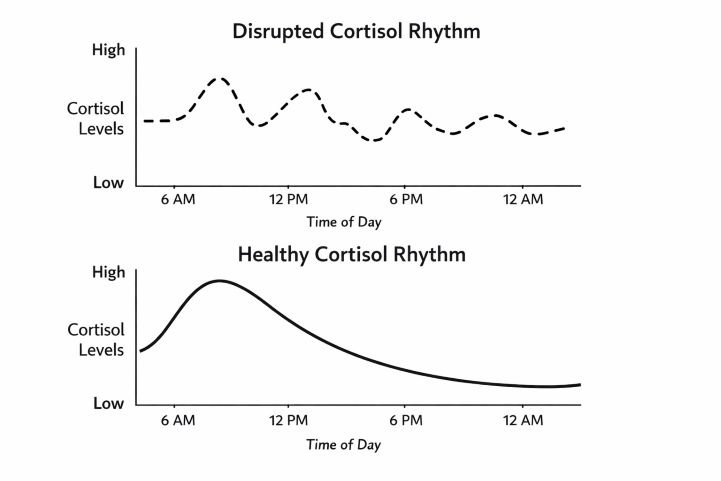
The hypothalamic-pituitary-adrenal (HPA) axis regulates the hormonal stress response, including cortisol release. Under chronic stress:
This hormonal dysregulation is one reason hyperarousal feels so resistant to “trying harder” to sleep.
Neurotransmitters such as serotonin and GABA support calm focus, emotional balance, and sleep readiness. Chronic stress disrupts these systems, contributing to:
Breathing is one of the fastest ways the nervous system communicates with the brain. Under stress, breathing often becomes rapid, shallow, or irregular—patterns that signal danger to the brain.
Gentle, rhythmic breathing supports carbon dioxide balance and vagal tone, helping the brain receive a message of safety. This shift is essential for reducing hyperarousal.
When the nervous system is overstimulated, access to the brain’s regulatory centers decreases. This can lead to:
During the day, distractions mask hyperarousal. At night, when external input decreases, internal activation becomes more noticeable—often resulting in racing thoughts, restlessness, or sudden anxiety.
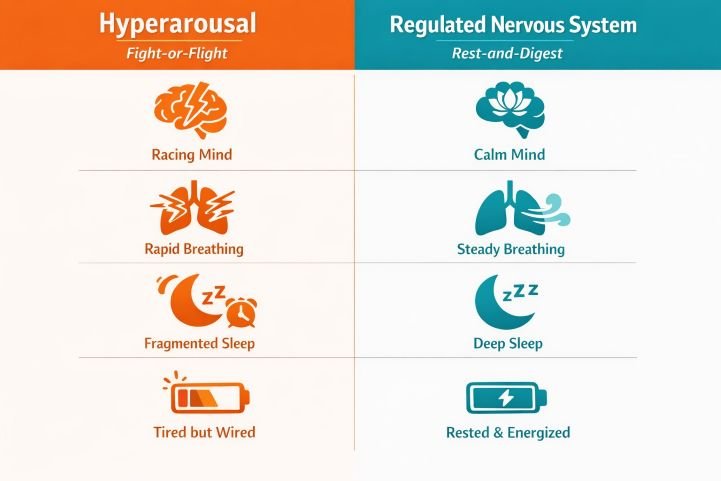
One way to understand hyperarousal is to compare how the nervous system functions in a high-alert state versus a regulated state.
| Aspect | Hyperarousal state | Regulated nervous system |
| Nervous system tone | Sympathetic (fight-or-flight) dominant | Balanced with parasympathetic (rest-and-digest) |
| Stress hormones | Elevated or mistimed cortisol | Healthy cortisol rhythm |
| Breathing pattern | Shallow, rapid, irregular | Slow, rhythmic, efficient |
| Sleep experience | Difficulty falling asleep, light or fragmented sleep | Easier sleep onset, deeper rest |
| Mental state | Racing thoughts, hypervigilance | Calm focus, mental clarity |
| Emotional regulation | Irritability, anxiety, reactivity | Emotional steadiness, resilience |
| Energy levels | “Tired but wired” | Rested, steady daytime energy |
| Recovery from stress | Slow or incomplete | Faster, more efficient recovery |
Many people attempt to “fix” hyperarousal with surface-level strategies:
While these may provide temporary relief, hyperarousal is physiological, not motivational. Without directly addressing the nervous system, symptoms often recur.
Regulation teaches the body how to:
Suppression, by contrast, attempts to override the stress response without resolving it.
Sleep is not something the body does by effort—it emerges when safety is restored. Regulation practices create the internal conditions that allow sleep to happen without force.
Structured breathing practices can:
Meditation practices that support deep rest and effortless attention can:
When paired with breath-based regulation, meditation helps reinforce the nervous system’s ability to shift out of hyperarousal and remain in balanced, restorative states—supporting both sleep quality and emotional resilience over time.
These shifts help quiet the mind and prepare the body for rest.
If anxiety or sleep struggles feel ongoing rather than situational, addressing the nervous system directly can make a meaningful difference.
The Art of Living Sleep and Anxiety Protocol is designed specifically to calm hyperarousal through guided breathing and deep rest practices—supporting better sleep, emotional balance, and long-term resilience.
👉 Explore the Sleep and Anxiety Protocol and learn how regulation supports real recovery.

The Sleep and Anxiety Protocol was created to address hyperarousal at its source—the nervous system.
Key elements include:
Rather than managing symptoms in isolation, the protocol helps retrain the body’s natural ability to return to a calm state.
As nervous system regulation improves:
Many people notice improved daytime energy, clearer thinking, and reduced anxiety as sleep quality stabilizes.
Addressing hyperarousal supports:
Most importantly, it restores trust between the mind and body.
Mental hyperarousal is not a personal failing—it is a natural response to prolonged stress and overstimulation. With the right tools, the nervous system can relearn how to rest.
By understanding the science behind hyperarousal and choosing regulation-based practices, it is possible to improve sleep, reduce anxiety, and experience calm that lasts beyond momentary relief.

If you’re ready to move beyond coping strategies and address the root causes of sleep disruption and anxiety, the Art of Living Sleep and Anxiety Protocol offers a science-informed, experiential approach to nervous system regulation.
👉 Learn more about the Sleep and Anxiety Protocol and take the next step toward restorative sleep and sustainable calm.
Mental hyperarousal is a state in which the nervous system remains on high alert even when no immediate threat is present. It is commonly associated with anxiety, racing thoughts, restlessness, and difficulty sleeping.
Sleep requires parasympathetic nervous system activation. Hyperarousal maintains the body in fight-or-flight mode, disrupting cortisol rhythms and preventing the nervous system from downshifting into a resting state.
Not exactly. Hyperarousal is a physiological state that often underlies anxiety. While anxiety is the felt experience, hyperarousal is the nervous system condition driving it.
Yes. Chronic stress, ongoing mental load, poor sleep, and constant stimulation can all lead to hyperarousal—even without a specific traumatic event.
Hyperarousal is driven by the nervous system rather than by conscious thought. Without first calming the body, the mind has a limited capacity to settle.
Breathing patterns directly influence the nervous system. Slow, rhythmic breathing supports vagal tone, improves carbon dioxide balance, and signals safety to the brain, helping reduce stress activation.
Regulation-based practices that work directly with the nervous system—such as structured breathing and deep rest—are most effective for restoring balance and improving sleep over time.
The Sleep and Anxiety Protocol is designed to address hyperarousal at its root through guided breathing and deep rest practices, helping to retrain the nervous system for improved sleep, reduced anxiety, and sustained calm.