

Stress
Learn what mental bandwidth is, how stress depletes it, and practical ways to restore focus, clarity, and productivity in daily life.

Updated on: 28th July 2026
Posted on: 7th January 2026
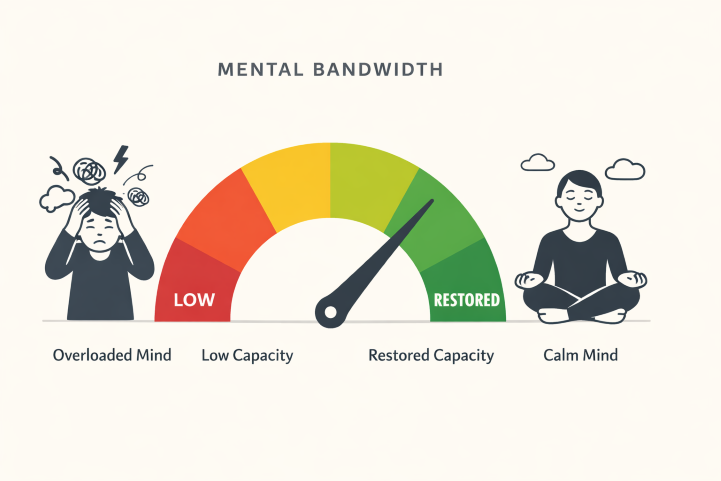
Mental bandwidth refers to the brain’s capacity to process information, manage emotions, and make decisions at any given moment. It determines how clearly you think, how well you handle stress, and how effectively you navigate daily life. When mental bandwidth is high, focus feels natural, and decisions feel easier. When it is depleted, even simple tasks can feel overwhelming.
In today’s always-on world, mental bandwidth is under constant strain. Notifications, deadlines, emotional stress, and information overload compete for limited cognitive resources. Most people assume they have complete control over their decisions, but in reality, limited mind bandwidth and cognitive biases play a significant role in shaping choices. Over time, this constant demand can lead to mental fatigue, reduced productivity, and a persistent sense of being “behind,” even when you are working hard.
Understanding this idea of limited mental capacity is crucial. It helps explain why certain behaviors or challenges arise when cognitive load is high. Instead of blaming yourself for a lack of discipline or motivation, you begin to recognize the roles of cognitive capacity and neural load. By learning how mental bandwidth works—and how to restore it—you can improve focus, decision-making, and overall well-being without pushing harder.
Managing mental bandwidth is not just about productivity. It is foundational to mental health, emotional balance, and quality of life. Mind bandwidth also affects impulse control and long-term planning, underscoring the importance of understanding and managing cognitive resources. When your brain has space, you think more clearly, respond rather than react, and feel more at ease in both work and relationships.
What is mental bandwidth?
Mental bandwidth is the brain’s capacity to process information, regulate emotions, and make decisions. Stress, distraction, and cognitive overload reduce mental bandwidth, making focus and productivity more difficult. Restoring mental bandwidth involves reducing mental load and supporting nervous system regulation.
Cognitive bandwidth comprises several mental resources that work together. These include working memory, attention, emotional regulation, and executive control—the skills that allow you to plan, prioritize, and follow through on decisions. The mental processes involved in managing these resources require significant cognitive engagement, primarily when multiple tasks or distractions compete for your attention.
Unlike physical energy, cognitive bandwidth is not always apparent until it runs low. You may notice increased irritability, difficulty concentrating, or a tendency to procrastinate or make impulsive choices. These are not personal failings; they are signs that mental resources are stretched thin.
A key point to understand is how digital overload floods the brain with dopamine, reducing the tolerance for sustained thought. Research in behavioral economics and psychology shows that scarcity—especially time scarcity—dramatically reduces cognitive bandwidth. When the mind feels rushed or overwhelmed, it narrows its focus to immediate concerns, leaving fewer resources for long-term thinking, creativity, and problem-solving. This creates a feedback loop: reduced bandwidth leads to poorer decisions, which in turn increase stress and mental load.
Understanding cognitive bandwidth enables individuals to work with the brain rather than against it. By reducing unnecessary demands and restoring mental space, it becomes possible to improve focus, resist distractions, and make more thoughtful decisions throughout the day.
Brain bandwidth is not a single function. It is the combined effect of several systems working together, including attention, working memory, and executive control.
Attention determines what information your brain prioritizes. Working memory holds information temporarily so it can be used for reasoning and problem-solving. Executive control helps regulate impulses, manage emotions, and shift between tasks when needed.
Every task draws from this shared pool of resources. Even something as simple as listening to the human voice typically occupies more than 50% of a person’s cognitive bandwidth, leaving less capacity available for other things. When you dedicate bandwidth to one activity, less remains available for different tasks, making multitasking difficult and often inefficient.
Research by Sendhil Mullainathan and Eldar Shafir highlights how cognitive load impacts decision-making. Their work shows that when bandwidth is reduced, people are more likely to make short-sighted decisions, overlook important details, and feel mentally trapped. The takeaway is clear: protecting brain bandwidth is essential for both performance and well-being.
Productivity is often framed as a matter of discipline or time management, but mental bandwidth plays a much larger role. When cognitive resources are available, productivity flows. When they are depleted, even the best plans can fall apart.
Mental health and well-being are deeply intertwined with productivity. Chronic stress, anxiety, and emotional strain consume brain bandwidth, leaving fewer resources for focus and creativity. Constant distractions—whether digital or emotional—fragment attention and increase mental fatigue. Even the simple presence of a phone or frequent notifications can consume brain bandwidth and impair focus, making it harder to concentrate on essential tasks. Engaging in a digital detox can help free up cognitive resources by reducing distractions and allowing the mind to recover.
Physical activity, adequate sleep, and regular recovery periods support brain function and help restore bandwidth. Importantly, nervous system regulation plays a key role. When the nervous system is stuck in a state of heightened alert, the brain remains preoccupied with perceived threats, reducing capacity for higher-level thinking. Individuals continually face stressors and responsibilities that consume their cognitive resources, making it essential to develop strategies for effective management.
Maintaining a healthy work-life balance is not a luxury; it is a requirement for sustained productivity. Preserving mental bandwidth enables consistent productivity rather than relying on bursts of effort followed by burnout.
Effective time management is less about squeezing more tasks into the day and more about reducing unnecessary cognitive load. When time is structured thoughtfully, the brain does not have to constantly decide what to do next, freeing up bandwidth for meaningful work.
Simple strategies can make a significant difference. Taking time to write down tasks and ideas reduces the burden on working memory. Breaking large projects into smaller steps prevents overwhelm. Avoiding multitasking allows attention to remain steady rather than fragmented.
Understanding scarcity also helps improve time management. When everything feels urgent, mental bandwidth shrinks. Structuring your time helps ensure sufficient focus for essential tasks. Learning to prioritize realistically and leave space between tasks can restore a sense of control and mental ease.
By managing time in ways that support cognitive capacity, individuals can accomplish more with less strain, thereby conserving mental bandwidth for decisions that truly matter. Communicating your bandwidth state to others can also foster understanding and support.
Decision-making and problem-solving place high demands on brain bandwidth. Each choice requires attention, emotional regulation, and evaluation of options. When bandwidth is limited, decisions become reactive rather than thoughtful, and the ability to act appropriately or perform tasks effectively is compromised.
People with greater available mental bandwidth tend to make clearer, more balanced decisions. They are better able to pause, consider alternatives, and respond intentionally rather than impulsively. When bandwidth is depleted, decision-making and mental processing can slow down, making it harder to evaluate options and respond effectively.
Strategies such as taking regular breaks, reducing emotional reactivity, and seeking input from others can help conserve bandwidth during complex decisions. Engaging in short, consistent focus drills can also reduce fatigue and improve cognitive performance. Creating mental space is often more effective than forcing solutions through sheer effort.
Understanding how brain bandwidth influences decision-making enables individuals to design their environments and routines to support clarity and confidence.
Mental health and well-being form the foundation of cognitive capacity. When emotional stress is high, the brain devotes significant resources to managing internal tension, leaving less capacity for focus and creativity.
Chronic stress and anxiety are particularly taxing on mental bandwidth. They keep the nervous system in a state of vigilance, which narrows attention and reduces cognitive flexibility. Over time, this can lead to exhaustion, burnout, and diminished performance.
Practices such as meditation, regulated breathing, physical movement, and meaningful social connection help restore balance. These practices do not add more tasks to the mind; they create space within it.
By prioritizing mental health and well-being, individuals do not compromise productivity. They are creating the internal conditions that enable sustainable productivity.

The Art of Living Part 1 Course offers a structured, experience-based approach to restoring and protecting mental bandwidth. Rather than relying solely on cognitive strategies, the course works directly with the breath, mind, and nervous system.
Through SKY Breath Meditation and other practical stress-release tools, the Part 1 Course helps calm the nervous system and reduce mental overload. When stress levels decrease, cognitive resources naturally become more available.
Participants often report improvements in clarity, emotional balance, focus, and resilience. These changes reflect an increase in usable brain bandwidth—the mental capacity required for thoughtful decision-making, creativity, and sustained productivity.
By addressing stress at its root instead of managing symptoms alone, the Art of Living Part 1 Course supports long-term mental efficiency and well-being.
Feeling mentally overloaded or stretched thin?
The Art of Living Part 1 Course teaches proven breathing and meditation techniques that help calm the nervous system, reduce stress, and restore mental clarity. By freeing up mental bandwidth at its source, many participants experience improved focus, better decision-making, and a greater sense of ease in daily life.
Join the Art of Living Part 1 Course and learn practical tools for sustainable focus and wellbeing.
A productive environment is a powerful ally in maintaining and enhancing your mental bandwidth. Careful research shows that the spaces where we work and live directly affect our cognitive capacity, executive control, and overall mental health. When your surroundings are organized and clutter-free, your brain’s ability to process information improves, reducing unnecessary mental effort and freeing up more cognitive bandwidth for essential tasks.
The way your brain works is closely tied to your environment. For example, studies have found that natural light and plants can boost mood, sharpen focus, and increase productivity. On the other hand, a constant stream of distractions—such as background noise, digital notifications, or visual clutter—can quickly deplete your available bandwidth, making it harder to concentrate and manage anxiety.
To optimize your environment for better cognitive function, consider strategies such as minimizing distractions, setting clear goals for each work session, and establishing routines that support mental well-being. Simple adjustments, such as keeping your workspace tidy, using noise-cancelling headphones, or adding a touch of greenery, can significantly improve your focus and performance.
By understanding the relationship between your environment and your cognitive capacity, you can take control of your surroundings and create a space that supports your brain’s ability to process, focus, and thrive. These small but meaningful changes can lead to improved performance, greater well-being, and a more sustainable approach to productivity.
Writing things down is one of the simplest ways to conserve mental bandwidth. When tasks, ideas, and concerns live only in the mind, they continuously draw on working memory.
Journaling, note-taking, and list-making externalize information, reducing cognitive load. This allows the brain to focus on processing and creativity rather than storage and recall.
Writing also supports emotional regulation. By putting thoughts into words, individuals often gain clarity and perspective, freeing up additional mental resources.
When used consistently, writing becomes a powerful tool for managing cognitive load and sustaining focus throughout the day.
Improving focus is less about forcing concentration and more about creating conditions that support attention. When mental bandwidth is protected, focus emerges naturally. It’s essential to monitor your body and the signs of stress to maintain mental clarity and prevent burnout.
Practices such as mindfulness, meditation, regulated breathing, and physical activity help stabilize attention and reduce mental noise. Reducing distractions, working in focused intervals, and taking restorative breaks also play an essential role.
Understanding how different tasks tax brain bandwidth allows individuals to plan their day more effectively. A difficult task can require greater cognitive effort and quickly deplete available focus. For example, performing mental arithmetic is a classic activity that consumes significant bandwidth. High-focus tasks can be scheduled during peak mental clarity, while lower-demand activities are placed elsewhere.
By respecting cognitive limits, focus becomes more sustainable and less exhausting. Engaging in brain exercises, such as puzzles or learning new skills, challenges the brain and helps improve cognitive capacity. To boost mind bandwidth for better productivity, prioritize sleep, nutrition, and exercise.
Enhancing your mental capacity is about more than just working harder—it’s about working smarter by supporting your cognitive bandwidth, working memory capacity, and executive control. Psychology employs a range of strategies to help individuals maximize their mental resources and improve overall cognitive function.
One of the most effective ways to boost mental bandwidth is through regular physical activity. Exercise has been shown to enhance cognitive function, increase working memory, and provide more available bandwidth for complex tasks. Recognizing that different tasks require varying levels of mental effort, it’s crucial to prioritize your workload based on complexity and importance, ensuring that your most demanding work gets your full attention when your cognitive resources are at their peak.
Mindfulness and meditation are also powerful tools for managing mental bandwidth. These practices help reduce mind-wandering and anxious thoughts, allowing you to focus more efficiently and make better use of your cognitive capacity. By incorporating mindfulness into your daily routine, you can improve your ability to resist temptations and make more thoughtful decisions.
The research of Sendhil Mullainathan and Eldar Shafir on scarcity highlights how limited mental bandwidth can impact decision-making and problem-solving. When your cognitive resources are stretched thin, it becomes harder to manage tasks, control impulses, and maintain a sense of well-being. Implementing strategies such as effective time management, structured problem solving, and regular breaks can help you manage your bandwidth and avoid the pitfalls of scarcity.
In recent years, the concept of mental bandwidth has gained significant attention in psychology, with ongoing research uncovering new ways to support mental health and cognitive function. Staying informed about the latest findings and proactively applying these strategies can help you optimize your mental capacity, improve your quality of life, and maintain greater control over your daily experience.
By understanding your mental bandwidth and actively working to expand it, you can make better decisions, manage your time more effectively, and enjoy greater well-being in both your personal and professional life.
Stress, anxiety, and constant stimulation are among the biggest obstacles to productivity. These factors drain brain bandwidth, making even simple tasks feel heavy.
Seeking support, practicing self-care, and learning techniques for nervous system regulation can help mitigate these obstacles. Recognizing early signs of overload allows individuals to intervene before productivity declines.
When obstacles are addressed at the level of mental and emotional load, productivity improves without requiring more effort or longer hours.
Momentum and motivation depend on having sufficient mental bandwidth to stay engaged over time. When cognitive resources are depleted, motivation fades quickly.
Setting realistic goals, tracking progress, and celebrating small wins help sustain momentum. Emotional balance and inner calm facilitate sustained consistency without burnout.
Protecting mental bandwidth supports not only productivity but also enjoyment and satisfaction.
Implementing mind bandwidth strategies does not require perfection. Small, consistent changes create meaningful results over time.
Combining time management, stress regulation, and restorative practices builds a strong foundation for focus and productivity. Structured techniques—rather than willpower alone—support long-term success.
When both the mind and nervous system are addressed together, mental bandwidth becomes more stable and accessible.
Mastering mind bandwidth is essential for focus, productivity, and overall well-being. By understanding cognitive limits and actively restoring mental space, individuals can work smarter, not harder.
Next steps include prioritizing mental health, reducing chronic stress, and learning practical tools that support nervous system regulation. When mental bandwidth is protected, clarity, resilience, and creativity follow naturally.

If you are ready to move beyond mental overload and experience greater clarity and balance, the Art of Living Part 1 Course offers a proven, practical pathway. Through guided breathing, meditation, and stress-release techniques, the course helps restore mental bandwidth so you can focus, decide, and live with greater ease.
Discover how the Art of Living Part 1 Course can support your mental clarity, productivity, and well-being.
Mental bandwidth is the brain’s available capacity to process information, manage emotions, and make decisions. It includes attention, working memory, and executive control. When mental bandwidth is high, you can focus, plan, and respond thoughtfully. When it’s low, even small tasks can feel effortful and overwhelming.
Low mental bandwidth is commonly caused by chronic stress, poor sleep, constant digital distraction, multitasking, and emotional overload. Time pressure and “scarcity thinking” (feeling like there’s never enough time or resources) can also reduce cognitive capacity, making it harder to concentrate and make clear decisions.
Common signs include difficulty focusing, forgetfulness, irritability, decision fatigue, procrastination, and feeling mentally “maxed out.” You may also notice more impulsive choices, reduced patience, and trouble prioritizing—especially when you’re stressed or rushing.
Stress activates the body’s threat response, which narrows attention and shifts the brain into short-term survival mode. In that state, more mental energy is allocated to vigilance and emotion processing, leaving fewer resources for working memory, planning, creativity, and problem-solving. Over time, chronic stress can make low mental bandwidth feel like a normal baseline.
Mental bandwidth is your overall available mental capacity at a given time. Cognitive load is the amount of that capacity a specific task (or set of tasks) requires. When cognitive load is high—too many tasks, too much information, too many decisions—it can exceed available cognitive bandwidth, creating cognitive overload.
Yes. Mental bandwidth is not fixed—it can be restored by reducing unnecessary demands and supporting recovery. Helpful approaches include better sleep, movement, hydration, and nutrition, simplifying decisions, taking breaks, and practicing stress regulation techniques such as mindfulness, meditation, and breathing practices.
Begin by reducing cognitive load: write tasks down, reduce multitasking, and set 1–3 priorities. Use short breaks to reset your attention (even 2–5 minutes helps). If you feel stressed, regulate first—slow breathing, a quick walk, or a brief meditation can calm the nervous system and free up mental space.
Yes. Multitasking requires the brain to switch contexts repeatedly, thereby increasing cognitive load and depleting attentional resources. Over time, it can lead to mental fatigue and reduced performance. Single-tasking—doing one meaningful task at a time—protects bandwidth and usually improves both speed and quality of work.
Writing things down offloads information from working memory, reducing mental clutter. Instead of trying to remember every task or idea, your brain can use that capacity for focus, problem-solving, and creativity. Lists, notes, and simple planning systems are practical ways to protect cognitive capacity.
Breathing and meditation support nervous system regulation, thereby reducing stress-driven mental noise and improving attentional stability. When the body is calmer, the brain can shift out of reactive mode and access more executive control—making it easier to concentrate, prioritize, and make thoughtful decisions.
The Art of Living Part 1 Course teaches practical breathing techniques and meditation that help reduce stress and calm the nervous system. When stress decreases, more mental bandwidth becomes available for focus, decision-making, and emotional regulation. Many participants report improved clarity, resilience, and greater ease in daily life.
If mental overload is persistent and impacts sleep, work, relationships, or daily functioning—or if you experience symptoms of anxiety or depression—it’s a good idea to seek support from a qualified healthcare or mental health professional. Skill-building practices can be helpful, but professional care may be essential when symptoms are severe or persistent.