


Benefits
Learn how meditation and SKY Breath Meditation reduce stress, slow brain aging, and enhance longevity for mind and body vitality.

Updated on: 9th January 2026
Posted on: 23rd September 2025
The search for longevity has been a human quest for centuries, and science is now uncovering the vital role meditation may play in slowing the aging process. Meditation practices, such as mindfulness and breathing-based techniques, are increasingly recognized for their ability to improve mental health, reduce age-related cognitive decline, and promote overall well-being.
Emerging research suggests that meditation not only enhances emotional regulation but may also positively affect the brain’s structure and function, reducing the risk of neurodegenerative diseases like Alzheimer’s. Stress, one of the most significant accelerators of aging, can be alleviated through regular meditation, potentially leading to a slower rate of brain aging.
Among the many techniques available, SKY Breath Meditation, taught by the Art of Living Foundation, has gained attention for its measurable impact on stress, immunity, and mental clarity. By combining rhythmic breathing patterns with mindfulness, SKY has been shown in published studies to significantly lower stress and anxiety—two factors closely tied to premature aging.
Decades of scientific research have revealed that meditation can profoundly influence both the mind and body in measurable ways. Meditation is not only about calming the mind but also about shifting physiological states that directly affect aging and overall health.
In short, meditation works on multiple levels—psychological, neurological, and physiological—to create conditions that support slower aging and greater longevity. While the precise biological mechanisms are still being studied, the evidence suggests that meditation is a powerful, low-cost, and accessible practice for enhancing life expectancy and quality of life.

One of the most fascinating areas of meditation research is its impact on what scientists refer to as “brain age.” Brain age is an estimate of how old the brain appears biologically compared to a person’s chronological age. A younger brain age generally reflects stronger cognitive functions, healthier neural connectivity, and greater resilience against decline.
Studies using advanced brain imaging techniques, such as structural MRI, have shown that long-term meditators often display a brain age that is 5–6 years younger than their non-meditating peers. This is not simply a matter of improved mood or reduced stress—it is a measurable difference in brain structure. Regions involved in memory, attention, and decision-making often appear denser and more connected in meditators, even into later life.
Meditation fosters neuroplasticity, the brain’s ability to reorganize and form new connections throughout life. With age, neuroplasticity typically declines, contributing to slower learning and a decline in memory. However, meditation practices—particularly rhythmic breath-based techniques like SKY Breath Meditation—stimulate neural pathways associated with focus, emotional regulation, and executive function. This activity strengthens synaptic connections and helps preserve grey matter volume, a hallmark of younger brain age.
Chronic stress accelerates brain aging by increasing cortisol levels, which in turn damage neurons in the hippocampus (the brain’s memory center). Meditation training directly addresses this problem. SKY Breath Meditation, for example, has been shown in peer-reviewed studies to significantly lower cortisol levels, creating a more protective environment for brain cells. Reduced cortisol supports better memory retention, learning ability, and overall cognitive health.
Brain imaging studies also reveal that meditation enhances connectivity between different brain regions, particularly those involved in attention and emotional processing. These networks often degrade with age, leading to scattered focus and emotional instability. Meditation, however, strengthens these circuits, effectively maintaining the brain’s communication channels in a youthful and efficient state.
Randomized controlled trials (RCTs)—the gold standard in scientific research—have consistently shown that meditation-based interventions improve both subjective well-being and objective measures of cognitive function. Participants engaging in structured practices, such as mindfulness meditation or SKY Breath Meditation, report sharper focus, better problem-solving abilities, and improved memory performance compared to control groups.
The implications of a younger brain age are significant. A younger biological brain can mean:
Meditation training, therefore, is not simply a relaxation practice—it is a brain-preserving intervention. By incorporating SKY Breath Meditation or similar techniques into daily life, individuals may not only feel younger but also preserve the biological youth of their brain well into older age.
Alzheimer’s disease is one of the most significant age-related conditions, characterized by progressive memory loss, cognitive decline, and changes in behavior. As life expectancy increases worldwide, Alzheimer’s has become a growing public health challenge. While no cure currently exists, preventive strategies are gaining attention—particularly meditation, which may play a role in delaying or reducing the risk of Alzheimer’s and related dementias.
Research suggests that regular meditation can lower several risk factors associated with Alzheimer’s. These include chronic stress, high inflammation, poor sleep, and impaired immune function—all of which are known to contribute to the development and progression of neurodegenerative diseases. By addressing these underlying drivers, meditation may offer a holistic way to slow the onset of cognitive decline.
One of the clearest connections between meditation and Alzheimer’s is stress reduction. Chronic stress elevates cortisol, which damages the hippocampus—the brain’s memory hub and one of the first regions to show deterioration in Alzheimer’s patients. Practices like SKY Breath Meditation help regulate the stress response system, lowering cortisol levels and potentially protecting hippocampal integrity. By reducing stress, meditation provides a buffer against the very brain changes that set the stage for Alzheimer’s.
Alzheimer’s is increasingly recognized as an inflammatory disease. Elevated inflammation accelerates the accumulation of amyloid-beta plaques and tau tangles, which are hallmarks of the condition. Meditation has been shown to lower pro-inflammatory markers in the body while boosting immune efficiency. SKY Breath Meditation, in particular, enhances parasympathetic nervous system activity, which reduces the chronic “fight-or-flight” stress response that drives inflammation.
Neuroimaging studies suggest that meditation enhances blood flow and oxygen delivery to key brain regions, including the prefrontal cortex and hippocampus. These areas are central to memory and executive function, both of which decline in Alzheimer’s. Regular practice also improves connectivity between brain regions, helping the brain compensate for early signs of degeneration.
Poor sleep is another risk factor for Alzheimer’s because deep sleep is critical for clearing toxic waste products, including amyloid-beta, from the brain. Meditation is associated with improved sleep quality, better regulation of sleep cycles, and enhanced restfulness. SKY Breath Meditation helps calm the nervous system, supporting deeper sleep and memory consolidation, both of which are vital for long-term brain health.
Alzheimer’s not only affects memory but also triggers emotional changes such as anxiety, irritability, and depression. Meditation improves emotional regulation and resilience, which can benefit both patients and caregivers. Programs that include SKY Breath Meditation have been shown to lower stress and burnout among caregivers, creating a more supportive environment for those living with the disease.
While more large-scale studies are needed, early research points to meditation as a promising, low-cost, and side-effect-free intervention for Alzheimer’s prevention. Preliminary evidence suggests:
Alzheimer’s disease cannot yet be prevented with certainty, but meditation adds a valuable tool to a holistic prevention strategy. Alongside nutrition, exercise, and mental stimulation, practices such as SKY Breath Meditation may help maintain brain health, reduce risk factors, and provide comfort for those already impacted by cognitive decline.
✨ Key Takeaway: While meditation is not a cure for Alzheimer’s, its ability to reduce stress, inflammation, and cognitive decline positions it as a vital ally in protecting the aging brain. Techniques like SKY Breath Meditation may offer hope not only for prevention but also for improving the quality of life for patients and caregivers alike.

Aging is the single most significant risk factor for neurodegenerative diseases such as Alzheimer’s, Parkinson’s, and Huntington’s disease. As the body ages, biological processes slow down, cells accumulate damage, and the brain becomes more vulnerable to inflammation, oxidative stress, and protein misfolding—all of which contribute to disease progression. While aging itself cannot be stopped, lifestyle choices, including meditation, can influence the way we age.
These processes create a perfect storm for neurodegeneration. However, meditation may help slow or buffer these mechanisms.
Meditation practices, including mindfulness and breath-based methods, are emerging as protective interventions against neurodegenerative diseases. Studies show that meditation can:

SKY Breath Meditation is particularly relevant for neuroprotection because of its dual impact on physiology and psychology:
Physiological: SKY’s rhythmic breathing patterns balance the autonomic nervous system, reducing chronic stress responses that accelerate brain aging. Lower cortisol levels, improved oxygen delivery, and enhanced parasympathetic activity all contribute to healthier neural environments.
Psychological: SKY reduces anxiety, depression, and emotional strain, which are known to worsen neurodegenerative symptoms. Enhancing mood and resilience, it helps preserve cognitive functioning and quality of life.
Neurodegenerative diseases often carry emotional burdens such as depression, irritability, and apathy. Meditation has been shown to improve emotional regulation by strengthening the connections between the amygdala (the emotional center) and the prefrontal cortex (the reasoning center). This regulation may ease the emotional symptoms of neurodegenerative conditions and reduce caregiver stress as well.
While meditation cannot eliminate the risk of neurodegenerative disease, it offers a promising, accessible, and non-invasive strategy to slow progression and improve well-being. When combined with other healthy lifestyle practices—such as balanced nutrition, regular exercise, and adequate sleep—meditation supports a more resilient brain and a gentler aging process.
✨ Key Takeaway: Aging and neurodegenerative diseases are deeply interconnected, but meditation, particularly SKY Breath Meditation, offers a scientifically grounded way to reduce risk factors, preserve brain function, and enhance emotional resilience, helping individuals age with greater vitality and mental clarity.
Cognitive functions—such as attention, memory, learning, and executive control—are essential for maintaining independence and quality of life as we age. While cognitive decline is often seen as inevitable, growing evidence suggests that meditation can help preserve and even enhance these abilities.
Meditation has repeatedly been shown to strengthen attention networks in the brain. A randomized controlled trial by Zeidan et al. (2010, Consciousness and Cognition) found that just four days of meditation training improved participants’ ability to sustain attention. Long-term meditators demonstrate enhanced selective attention and resistance to distractions.
SKY Breath Meditation impact:
Research from Seppälä et al. (2020, Frontiers in Psychiatry) indicates that SKY training enhances mental clarity and reduces distractibility by calming overactive stress responses, enabling practitioners to remain more focused and present.
Memory decline, particularly in working and episodic memory, is a hallmark of the aging process. Meditation appears to counteract this. A study by Luders et al. (2009, NeuroImage) found increased grey matter density in the hippocampus of long-term meditators—a brain region critical for learning and memory. Similarly, Gard et al. (2014, Frontiers in Psychology) demonstrated that mindfulness meditation improved working memory in older adults.
SKY Breath Meditation role:
A study conducted at Stanford University (Brown & Gerbarg, 2005; reviewed in Journal of Alternative and Complementary Medicine) highlighted that SKY reduces cortisol levels, which, when excessive, can damage hippocampal neurons. By lowering stress hormones and improving sleep, SKY supports memory consolidation and recall.
Executive functions such as planning, problem-solving, and cognitive flexibility decline with age due to changes in the prefrontal cortex. Meditation strengthens this region. Hölzel et al. (2011, Psychiatry Research: Neuroimaging) found increased cortical thickness in the prefrontal cortex after an eight-week meditation program. These structural changes correlated with improvements in self-regulation and decision-making.
SKY Breath Meditation findings:
In a study on healthcare workers during the COVID-19 pandemic, Baskin et al. (2020) reported that SKY improved emotional regulation, decision-making, and resilience—key aspects of executive function.
Emotional regulation plays a direct role in cognitive performance. Stress, anxiety, and depression impair attention, memory, and executive control. Meditation reduces emotional reactivity by strengthening connections between the prefrontal cortex and amygdala. Desbordes et al. (2012) demonstrated that mindfulness meditation led to enduring reductions in amygdala reactivity to stress.
Evidence from SKY:
A randomized controlled trial by Kjellgren et al. (2007, Journal of Alternative and Complementary Medicine) found that SKY significantly reduced anxiety and depression, indirectly supporting cognitive performance by freeing up mental resources for learning and focus.
Meditation improves cognitive health through multiple biological pathways:
✨ Key takeaway: Data strongly support meditation as a protective factor for cognition. From increasing hippocampal volume to reducing stress-related cognitive decline, practices like SKY Breath Meditation not only preserve attention, memory, and executive function but also build long-term resilience against age-related impairments.
| Study / Authors | Journal / Year | Population / Method | Key Findings on Cognition |
| Zeidan et al. | Consciousness and Cognition, 2010 | 63 participants, 4 days of meditation training | Improved sustained attention and ability to recover from distraction. |
| Luders et al. | NeuroImage, 2009 | MRI scans of long-term meditators vs controls | Increased grey matter density in hippocampus (memory/learning). |
| Gard et al. | Frontiers in Psychology, 2014 | Older adults, mindfulness training | Improvements in working memory and cognitive flexibility. |
| Hölzel et al. | Psychiatry Research: Neuroimaging, 2011 | 8-week MBSR program | Increased cortical thickness in prefrontal cortex, linked to better executive function. |
| Lazar et al. | NeuroReport, 2005 | Experienced meditators | Reduced age-related cortical thinning; preserved grey matter volume. |
| Desbordes et al. | Frontiers in Human Neuroscience, 2012 | fMRI before/after meditation training | Reduced amygdala reactivity → improved emotional regulation supporting cognition. |
| Creswell et al. | Brain, Behavior, and Immunity, 2012 | Mindfulness intervention | Reduced inflammation markers linked to cognitive decline. |
| Dasanayaka et al. | Frontiers in Psychology, 2022 | Meditation practitioners | Longer telomeres & higher telomerase activity → protection against cellular aging of brain. |
| Fox et al. (meta-analysis) | Neuroscience & Biobehavioral Reviews, 2014 | Review of 21 neuroimaging studies | Consistent structural changes in brain regions for attention, memory, and executive function. |
| Seppälä et al. (SKY Breath) | Frontiers in Psychiatry, 2020 | Randomized trial, healthcare workers during COVID-19 | SKY reduced stress, improved clarity, resilience, and focus. |
| Kjellgren et al. (SKY Breath) | Journal of Alternative and Complementary Medicine, 2007 | Participants in SKY program | Significant reduction in anxiety/depression → indirect cognitive benefits. |
| Brown & Gerbarg (review) | JACM, 2005 | Review of SKY and breathing-based meditation | SKY lowers cortisol, improves memory, and enhances emotional regulation. |
| Baskin et al. (SKY Breath) | Frontiers in Psychiatry, 2020 | Healthcare providers | SKY training improved decision-making, resilience, and executive functioning. |
✨ At a glance:
Over the last two decades, a growing number of systematic reviews and meta-analyses have synthesized evidence on the effects of meditation across various mental, cognitive, and biological outcomes. Taken together, these reviews reveal a consistent pattern: meditation yields reliable, clinically meaningful benefits for psychological stress, anxiety, and depression, as well as more modest but promising effects for cognition, inflammation, and cellular markers of aging. However, reviewers repeatedly flag methodological limitations that temper confidence and point to where stronger trials are needed.
Systematic reviews typically report small-to-moderate effect sizes for psychological outcomes and small effect sizes for cognitive or biological outcomes. In practice, this means meditation is comparable to other non-pharmacological interventions (e.g., physical activity, cognitive training) in producing meaningful improvements in quality of life, with the advantage of low cost, low risk, and ease of dissemination.
Breath-based programs such as SKY (Sudarshan Kriya Yoga) appear in the literature as part of several randomized trials and smaller pilot studies. Systematic reviews tend to group SKY with other rhythmical breath-based interventions; positive findings for SKY generally mirror the broader meditation literature—reductions in stress/anxiety, improvements in mood, and preliminary biological changes (e.g., lowered cortisol, improved immune markers). However, SKY-specific data are fewer than for mindfulness-based programs (MBSR/MBCT), so reviewers commonly call for larger, rigorously controlled trials that directly compare SKY to active controls and other meditation forms.
Bottom line: Systematic reviews paint a cautiously optimistic picture. Meditation—across traditions, including breath-based programs like SKY—has robust evidence for improving mental health and promising, though currently weaker, evidence for cognitive and biological aging outcomes. Strengthening the field will require larger, more rigorous trials that harmonize methods and measure mechanisms longitudinally.

At the cellular level, aging is marked by gradual declines in repair capacity, mitochondrial function, and genomic stability. One of the most widely studied biological markers of aging is telomere length—the protective caps at the ends of chromosomes. Each time a cell divides, telomeres shorten, eventually leading to senescence or cell death. Chronic stress, inflammation, and oxidative damage accelerate this process, increasing the risk of age-related disease.
A growing body of preliminary evidence suggests that meditation may slow cellular aging by influencing telomere length and telomerase activity.
Chronic psychological stress accelerates cellular aging through high cortisol levels, increased inflammation, and oxidative damage. Meditation appears to buffer these effects:
Emerging research suggests that meditation also supports mitochondrial function, which is crucial for cellular energy and resilience.
SKY’s rhythmic breathing practice reduces sympathetic overactivation (“fight-or-flight” stress response) and enhances parasympathetic activity, creating an internal environment favorable for cellular repair and stability. Lowered stress hormones, reduced inflammation, and improved oxygenation all contribute to healthier cells. Although telomere-specific SKY studies remain limited, early research suggests potential downstream effects on biological markers of aging.
While findings are promising, most studies on telomeres and meditation are small, short, and often lack active control groups. Measurement methods for telomere length also vary, making results difficult to compare across studies. Systematic reviews emphasize the need for larger, long-term randomized controlled trials with standardized biomarker protocols to confirm whether meditation has a meaningful impact on cellular aging.
Key takeaway
Preliminary research points to a biological link between meditation and slower cellular aging. By reducing stress, lowering inflammation, and potentially maintaining telomere length, meditation practices such as SKY Breath Meditation may help preserve cellular vitality and delay the onset of age-related diseases. While definitive proof requires larger trials, the convergence of psychological, neurological, and cellular evidence suggests that meditation is a promising avenue for promoting healthy longevity.
| Study / Authors | Journal / Year | Population / Method | Findings Related to Cellular Aging |
| Daanayaka et al. | Frontiers in Psychology, 2022 | Review of stress & telomeres | Chronic stress linked to shorter telomeres; meditation hypothesized to protect telomeres by lowering stress hormones. |
| Jacobs et al. | Psychoneuroendocrinology, 2011 | 30 participants, 3-month meditation retreat | Higher telomerase activity in meditators compared to control group. |
| Alda et al. | PLoS One, 2016 | Cross-sectional, 20 long-term meditators vs controls | Long-term meditators had significantly longer telomeres. |
| Schutte & Malouff (meta-analysis) | Mindfulness, 2014 | Review of 12 studies | Meditation linked to longer telomeres and higher telomerase activity, though results varied. |
| Creswell et al. | Brain, Behavior, and Immunity, 2012 | Adults in mindfulness program | Reduced pro-inflammatory cytokines (IL-6), indicating protection against cellular aging. |
| Black & Slavich | Annals of the NY Academy of Sciences, 2016 | Systematic review | Meditation alters gene expression tied to inflammation and oxidative stress pathways. |
| Bhasin et al. | PLoS One, 2013 | Relaxation response (incl. meditation), gene expression analysis | Downregulation of genes linked to stress; upregulation of genes for mitochondrial function and energy metabolism. |
| Kjellgren et al. (SKY) | Journal of Alt. & Comp. Medicine, 2007 | Adults in SKY Breath Meditation program | Significant reductions in anxiety/stress → indirect protection for telomere health. |
| Seppälä et al. (SKY) | Frontiers in Psychiatry, 2020 | Healthcare workers, RCT | SKY lowered stress and improved resilience, suggesting downstream effects on stress-related cellular aging pathways. |
✨ At a glance:
Chronological age—measured simply by the number of years lived—is often viewed as an inevitable marker of decline. Yet research increasingly shows that biological age (how quickly the body and brain actually wear down) can differ dramatically between individuals of the same chronological age. Stress, lifestyle, and psychological resilience play central roles in accelerating or slowing this biological clock. Meditation emerges as a promising tool for decoupling chronological age from biological decline.
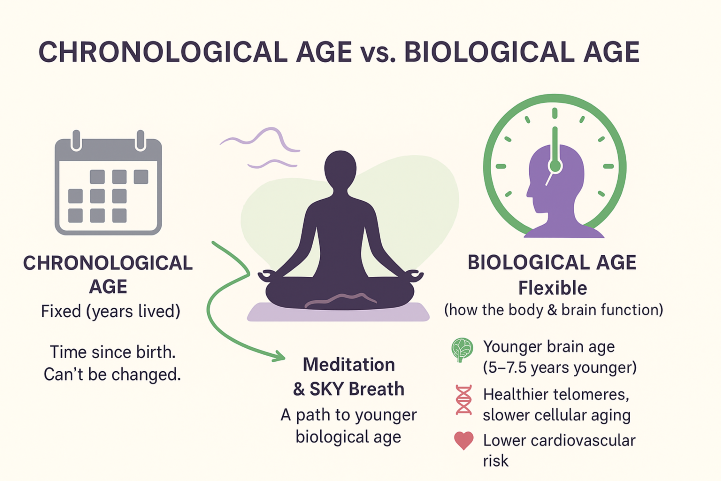
Breath-based practices such as SKY Breath Meditation may help slow the effects of chronological aging through several mechanisms:
Meditation does not change the passage of time, but it may alter how we experience age and how our bodies respond to it. Older adults who meditate regularly often report:
This suggests that while chronological age is fixed, meditation can influence functional age—how capable and resilient someone remains across physical, emotional, and cognitive domains.
Key takeaway
Meditation, including SKY Breath Meditation, can help individuals feel and function as though they are biologically younger than their chronological age. By reducing stress, protecting cellular health, and preserving brain structure, meditation offers a way to extend healthspan—even if not lifespan itself.
| Aspect | Chronological Age (Years lived) | Biological Age (How the body/brain actually function) | Impact of Meditation (incl. SKY Breath) |
| Definition | Fixed measure of time since birth | Reflects physical, cognitive, and cellular health | Meditation can help align biological age with—or even make it younger than—chronological age |
| Brain Health | Age-related shrinkage and decline expected | Rate of decline varies based on lifestyle and stress | Meditators show 5–7.5 years “younger” brain structure (Luders et al., 2016) |
| Cellular Health | Telomeres shorten naturally with age | Rate of telomere shortening influenced by stress & lifestyle | Meditation linked to longer telomeres and healthier cell repair (Jacobs et al., 2011) |
| Stress Response | Stress accumulates over time | Chronic stress accelerates biological aging | Meditation reduces cortisol and improves resilience; SKY proven effective for stress regulation |
| Immune Function | Immune efficiency declines with age | Poor stress management worsens decline | Meditation improves immune markers, reduces inflammation, and enhances recovery |
| Cardiovascular Health | Risk of heart disease increases with age | Risk amplified by hypertension, stress, poor lifestyle | SKY lowers blood pressure, improves heart-rate variability, reducing cardiovascular aging risk |
| Quality of Life | Often declines with advancing years | Can remain stable with healthy practices | Meditators report higher vitality, emotional balance, and well-being, regardless of age |
The idea that meditation may help slow the aging process has shifted from philosophical speculation to a growing area of scientific inquiry. While aging is inevitable, research suggests that the rate at which we age is not fixed. Lifestyle factors—diet, sleep, stress, and mental health—play powerful roles in determining whether we experience a vibrant, extended healthspan or premature decline. Meditation, including structured breath-based practices such as SKY Breath Meditation, is emerging as a key tool in protecting the body and brain from accelerated aging.
It’s not only about living longer, but living better. Meditation contributes to healthspan—the period of life lived free from chronic disease and decline—by:
While mindfulness and traditional meditation practices are powerful, SKY Breath Meditation adds another dimension through rhythmic, cyclical breathing that systematically reduces stress, energizes the body, and stabilizes emotions. Clinical research shows that SKY:
The evidence suggests that meditation does not stop the clock, but it can help us feel younger, think sharper, and live with greater energy—adding life to our years, not just years to our life.
✨ Takeaway: Meditation—especially structured practices like SKY Breath Meditation—does not promise eternal youth, but it may help us age more gracefully, protect our brain health, and extend vitality into the later decades of life.

The science is clear: practices like meditation and SKY Breath can help slow biological aging, support brain health, and bring greater joy to your everyday life. Why wait to feel younger inside and out?
👉 Discover the power of SKY Breath Meditation with the Art of Living Part 1 Course. In just a few days, you’ll learn tools to calm the mind, recharge your body, and create lasting changes for your well-being and longevity.
✨ Start your journey today—because while you can’t change your chronological age, you can change how you experience it.