What are the differences between sleep and meditation? Here’s how to find out if you’re sleeping during meditation and what you can do about it.


If you are reading this, you have probably wondered if that deep meditation experience was actually an experience of deep sleep.
Is there any way you can be sure you were meditating and not sleeping? Yes! Let’s start by defining meditation.
What is meditation?

Like many things, there are different opinions about what meditation is and isn’t. To begin to understand what meditation is, it’s important to understand the goals of meditation. If the goal is to experience reduced stress, anxiety, and depression as well as increased happiness, optimism, and overall health, then there are meditation methods you need to use, and some methods are not worth the time and effort.
There are some misconceptions about meditation. One of the biggest misconceptions is that to meditate, you need to apply effort, such as when concentrating, focusing, or even contemplating. That doesn’t mean that techniques that utilize these methods don’t have benefits, but they do not lead to a deep meditative experience nor the expected benefits of meditation.
Art of Living founder and master of meditation Gurudev Sri Sri Ravi Shankar has simplified the practice of meditation so more people can enjoy its many benefits.
Gurudev says, “In meditation, you do not do gymnastics with the mind or force anything...many people think meditation is an exercise of concentration. That is not the case. It is deep relaxation. You simply have to let go (of all your efforts).”
How you get to a state of meditation is one aspect, and how it should feel is yet another. Meditation should be relaxing for both the body and mind. Less thoughts and feeling lighter are also signs of meditation. And if you have experienced deep meditation, that’s where you might start to wonder if you actually fell asleep. This is because resting deeply in meditation and sleep share some similarities.
Similarities between meditation and sleep


Increased theta brain waves
Reduced heart rate
Reduced respiration
Both provide needed rest
Both have a part in mental and physical health
Increased delta waves are possible in deep sleep and deep meditation
No wonder it is sometimes difficult to know if we are sleeping or meditating!
Key differences between meditation and sleep

Meditation is typically practiced during the day, while sleep typically happens at night
Meditation is meditative alertness, while sleep is a state of reduced consciousness
Meditation releases stress, while sleep gives a pause from stress
After meditation, the mind feels clear; after sleep, the mind can feel dull
Meditation increases joy, while sleep tends to have a more neutral effect on the state of mind
The most significant difference is that sleep maintains the mind and body, while meditation improves the mind and body
How can I tell if I am sleeping in meditation?


Here are seven questions to help you figure out whether you were sleeping or meditating.
Q: Were you snoring?
A: If yes, you were sleeping.
Q: Did you drool?
A: If yes, you were sleeping.
Q: Were you in a group meditation?
A: If yes, you were probably meditating. It is unlikely that you would fall asleep in a group of people unless you have a big sleep deficit.
Q: Did your chin drop to your chest?
A: If yes, you were likely in a deep state of meditation.
Q: Did you lose track of time and place?
A: If yes, you were probably meditating.
Q: Were there less thoughts?
A: If yes, you were meditating.
Q: Did your breath slow down or seem to stop?
A: If yes, then you were meditating.
What can you do to prevent falling asleep in meditation?

According to the Centers for Disease Control, in 2022, 13.5% of US adults felt very tired or exhausted most days. Fatigue is a real problem. But if you’re stressed on top of that fatigue, you are likely to struggle with poor sleep patterns while your physical health deteriorates. It's a vicious cycle. Here’s how to break that cycle.
Practice meditation every day (even if you fall asleep).
Get enough exercise.
Practice yoga before meditation.
Reduce screen time.
Eat a well-balanced diet rich with fresh fruits and veggies.
Can meditation replace sleep?

What’s the first thing a busy person will give up? Sleep. But science says inadequate sleep not only leads to poor health but also to more stress. And guess what? Stress interferes with sleep!
We are simply hard-wired to require sleep. Without it, we can decline rather quickly. In twenty-four hours, our cognitive abilities are similar to someone with a blood alcohol level of 0.10%! After about three days, we start to hallucinate.
A deep meditation can be twice as deep as sleep, but it cannot replace sleep. Some things that the body requires can only be accomplished through getting enough sleep.
If you’re not getting enough good-quality deep sleep, you will not only fall asleep in meditation, but you will also increase your chances of getting stuck in a cycle of poor sleep and increasing stress levels.
Rather than trying to replace sleep or get by on less sleep, add meditation and improve your sleep quality.
How meditation affects sleep
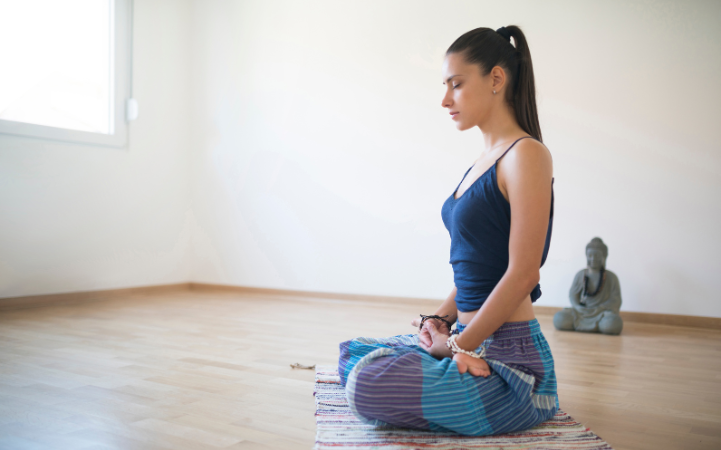

Because meditation relaxes the mind and body, you can fall asleep faster.
Because meditation reduces the stress hormone cortisol, you can fall asleep and stay asleep.
Because meditation increases the production of the sleep hormone melatonin, you can more easily fall asleep and wake up according to natural circadian rhythms.
Because meditation reduces thoughts, you are less likely to toss and turn and more likely to fall asleep naturally.
Guided meditation for better sleep
One of the easiest tools for better sleep is simple guided meditation. Here are two excellent choices, both led by Gurudev.
In the first guided meditation session, Gurudev leads you into a deeply relaxing meditation experience that will reduce stress levels and help you sleep better later in the evening.
The second guided meditation is a Non-Sleep Deep Rest (NSDR) practice that will leave you feeling refreshed and energized. Some people have even used this meditation practice while lying awake in bed, though there is some risk of waking up in the middle of the night. Many others have used this NSDR practice after waking up in the middle of the night to fall back to sleep. Try it and see where it can help you best.
Strengthen both meditation and sleep with guided support

Once you understand the difference between meditation and sleep, it's easier to optimize both. The Sleep and Anxiety Protocol helps your body transition from mental stillness into deep rest by teaching guided practices that reduce evening anxiety, slow your heart rate, and prepare your mind for sleep.
If you want to elevate your meditation routine while improving the quality of your sleep, this structured program provides an ideal next step.
Related articles


Meditation for Better Sleep: How to Tuck Your Mind Into Bed
Sleep Tips from an Ayurvedic Practitioner and Former Insomniac


