

In our country, we never separated spirituality from science. Science is a path towards spirituality and spirituality is part of science.
Navratri: Getting back to the Source
‘Nava’ has two meanings- ‘nine’ and also ‘new; and it is an occasion that brings freshness and rejuvenation in our lives as we get back to our source for these nine nights, taking our mind off all the day-to-day botherations, and spend time in self-enquiry. Then we become more creative, you become victorious.
When negative thoughts enter the mind, or when we have moved away from our nature, that’s when we find we get disturbed, we are unpleasant to be around, and we become unproductive and non-creative. And you can find relief from this negativity only when you go to the source of energy within you – the Shakti.
The science behind Navratri: Connecting the Macrocosm with the Microcosm
The story of Raktabeejasura indicates that our qualities are embedded in our DNA. Just as from each drop of the demon, a new demon was born, which means each drop had the makings of the whole demon, who we are, and who we have been-it is all encoded in our DNA. So the transformation has to happen from the very basic level and it is only the Devi who brings this transformation in us. Mother Divine comes with her trident which represents 3 things – wisdom, love and action.
She frees us from the asuras, the negative qualities that are present inside. Even if they are present in our DNA, they will be eliminated by the grace of Mother Divine. So, when you do sadhana or spiritual practices, when the spiritual energy in you is awakened, it sets right your entire physiology, it brings you the right mindset, right thought and the right expression of life. It is not just on the thinking level, it is on the existential level that the transformation occurs.
One in the many
Your mind is a small part of a big mind, your body is a part of the entire existence. If there is some problem in the air, not only one person is going to get affected but everything around will be affected. The environment is our first body, our food is from the environment, that’s why it’s called Annamaya Kosha. Vedanta and quantum mechanics are very close, very similar. Quantum mechanics says this whole universe is just made up of one wave function; Vedanta says the same thing – the whole universe is just vibrations, spandana, and pulsation. And the vibration in its many manifestations has formed this multitude of universe; and that One Vibration has manifested as millions of names and forms. That’s what the verses chanted in Navratri days are about, how the Divine Mother is manifest everywhere – all the qualities are Her; she is present in every atom of this creation, in the animals, trees, insects, galaxies and in many many worlds, and planets. Her glory is spread from an atom to the cosmos. So we adore the Mother Divine in all forms and feel the energy in the Annamaya Kosha.
When you listen to the story of Mother Divine, worship her; then the energy in you wakes up, prana wakes up; then you receive blessings, and all your desires come to you.
-Gurudev Sri Sri Ravi Shankar
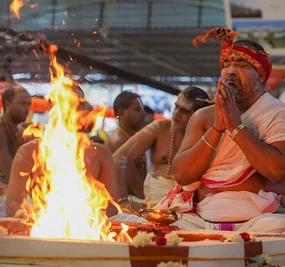
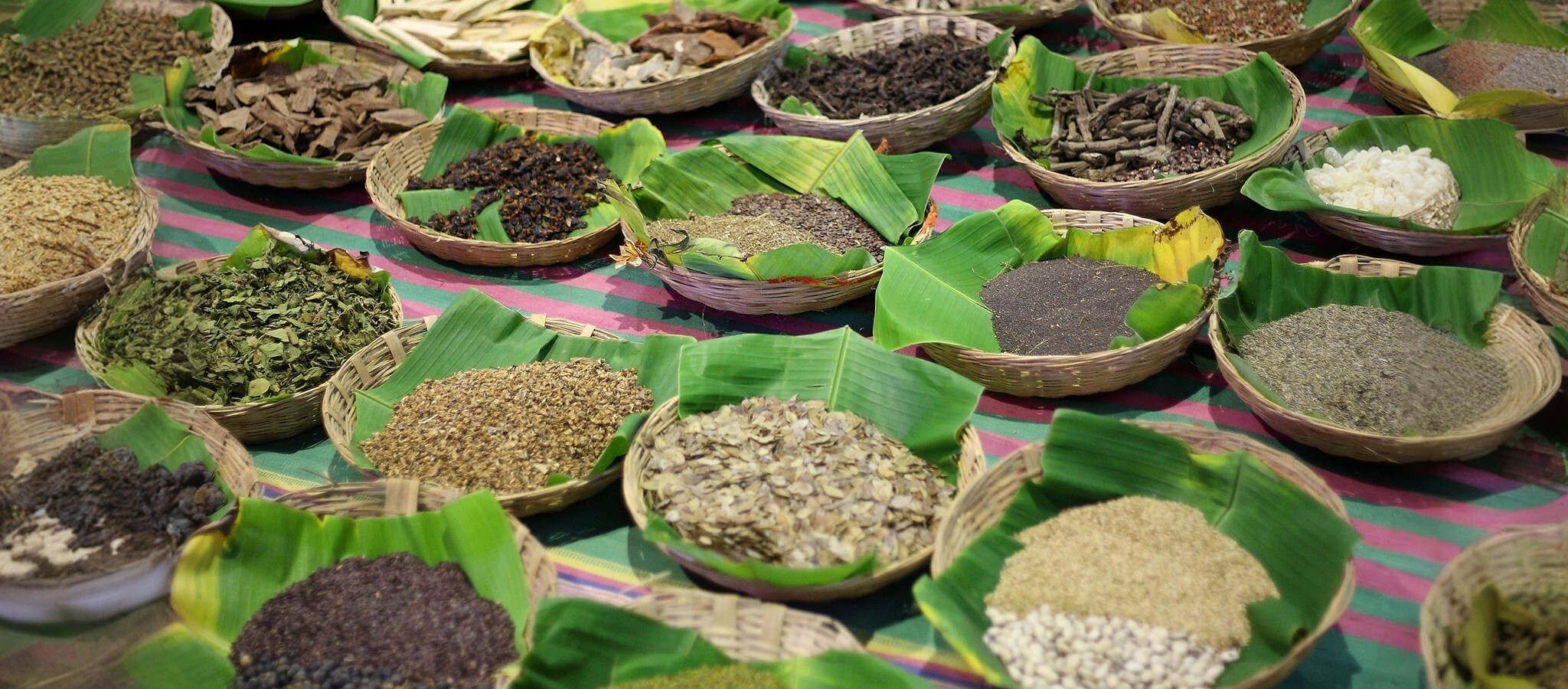
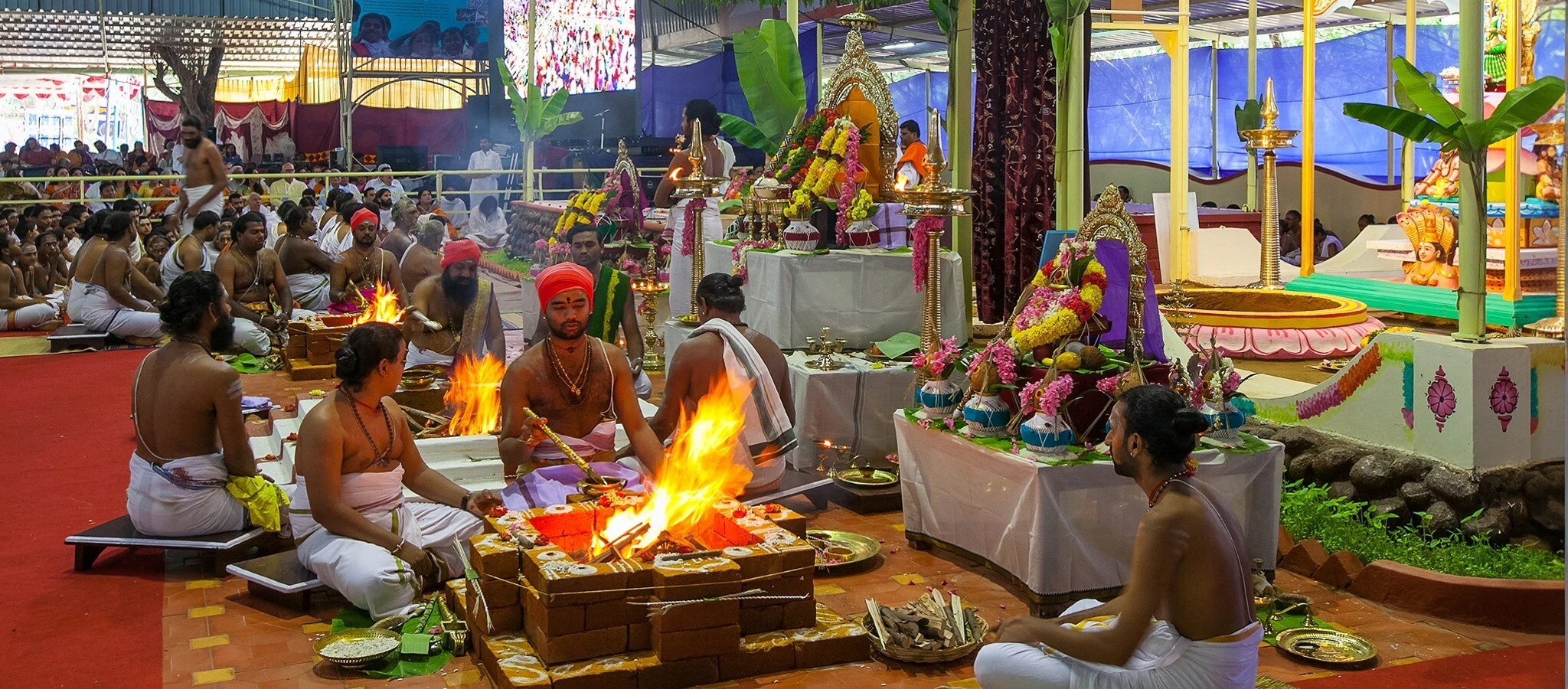
So, they cognized elaborate methods to connect the macrocosm with the microcosm; wherein every aspect of life is involved and that is what is called yagya. The yagya here is done for the whole world, for the welfare of all human beings; and the procedures are laid down in the scriptures – How many herbs should be bought? Which materials should be used? What chanting and mantras should be used? It’s all very precise, when it is done in the way it should be done, the impact of it is very imminent.
Our mind is tired of swaying between cravings and aversions, and the right and wrong. Navaratri is the time to just drop everything, and when we drop everything and repose in ourselves then deep meditation, samadhi, happens. That is the basis of all success in life.
Offering all the good and bad qualities; the past, present and the future to the Divine Mother, we repose in ourselves. And that is the essence of Navratri, to give deep rest to our mind and soul.
Significance of Rituals: Why Rituals Matter?
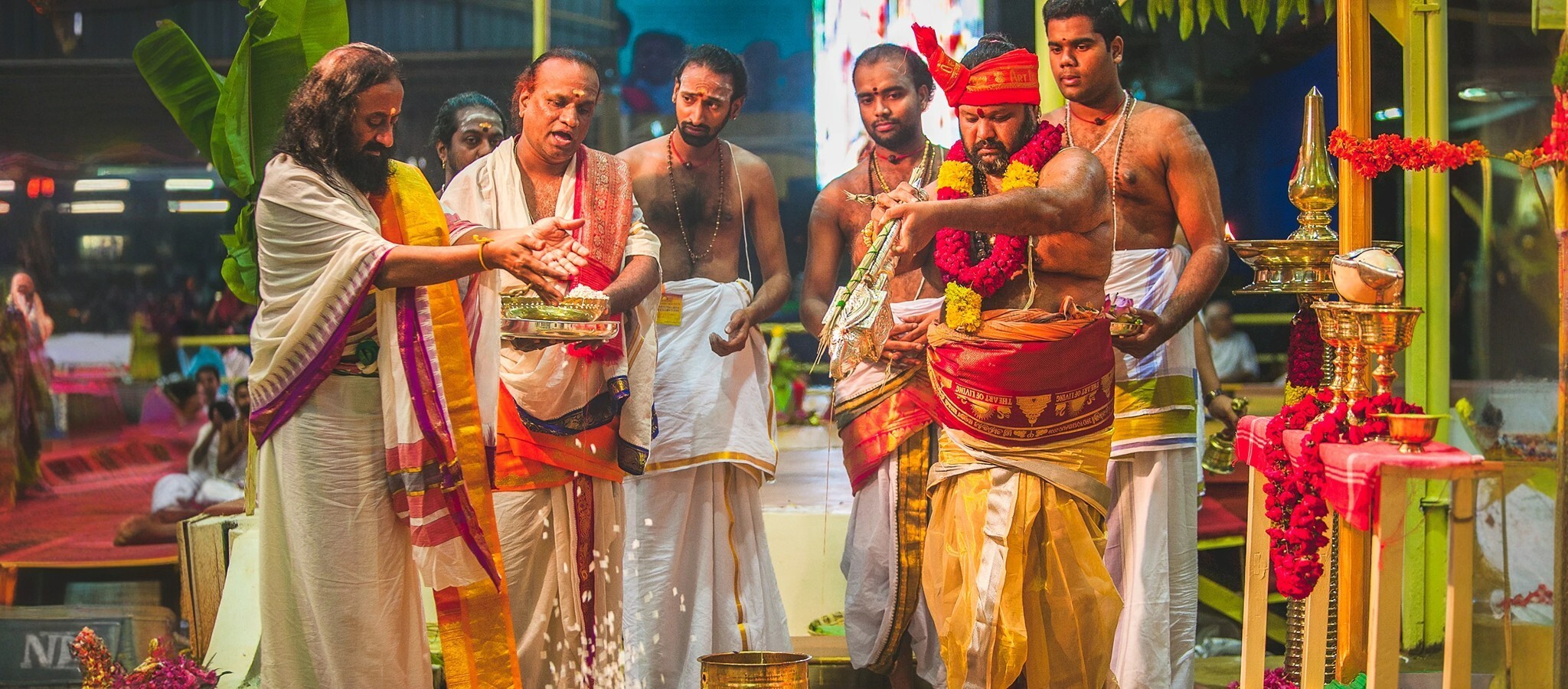
A little bit of engaging in rituals focuses the mind and creates a positive and celebrative atmosphere. Every ritual of the ancient people has some sort of significance, it has a specific impact on the environment and the subtle world.
The mantras are chanted with water, and the water absorbs certain vibrations. We have seen experiments on how water crystals respond to your thoughts. Every single thought you have has an impact on the cosmos.
Have you heard about the Butterfly Effect? One butterfly fluttering its wings in South America has an impact on the movement of clouds in China. That shows how powerful every single move of beings could be on everything else around them. The ancient people knew the connection between the macrocosm and the microcosm, and the parts of our body. The cosmos, the planets, the cosmic rays, and the vibration are connected to a particular bird, particular grain, herb or particular part of your human body. Navaratri is the time to explore this deep connection.
The Science Behind the Rituals
YAGYAS – a science of bringing the unmanifest energy into the manifest world
With yagya and tapas, one attains the highest Self. Yagya includes three elements: Dev puja – honouring the diverse divine qualities and energies. Each has a particular quality or use, and these are connected with different mantras, and herbs. Different plants are assigned to a particular vibration and definite energy, and so they express the unmanifest divinity. Every animal, for example, radiates a particular energy. Sangatikaran –everyone moving together. Yagya cannot happen alone because we are connected with everybody. If one is affected, in some degree it will affect others too; and daan – giving, sharing.
The yagyas, through different mantras, enlivens specific qualities in our consciousness. Specific yagyas with specific mantras have a specific influence on us, on our environment, on our collective consciousness, collective mind and individual mind.
Lord Krishna says – in the world, the yagyas are performed because they quickly produce beneficial results.
In yagya, the first thing is they sow all the different types of seeds. The life in the seed, though it has prana all the time, is manifested only when it sprouts. Similarly, Yagya is done by creating prana all around the mantap. The seeds sprout and they bring the prana shakti down from the space element. On the last day, the end of the ceremony, everyone dances around the sprouts, celebrating life, washed in the high prana. So the through the yagya – the prana is invoked in the water, fire, earth, in all the five elements; and then you see the bliss sprouting in the whole atmosphere with all the chants, bhajans, music and dance.
IDOL DÉCOR – the philosophy behind
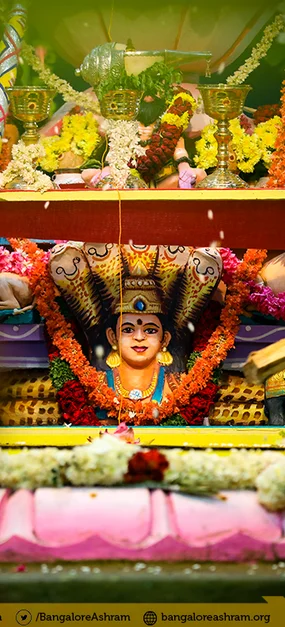
Your mind is attracted towards everything bright and colourful- the jewellery, clothing, flowers, and fragrance; so to arrest your senses, they put it all on the statue. When it is on the statue, you can’t possess it; so you have reverence for it. You stand in front of the deity and close your eyes; this indicates that God is within you. This is an arrangement to go inward.
Aarti
We pray – our life is like a lamp, and just like the lamp let my 5 senses, my life, move around you Mother Divine.
Tirtham
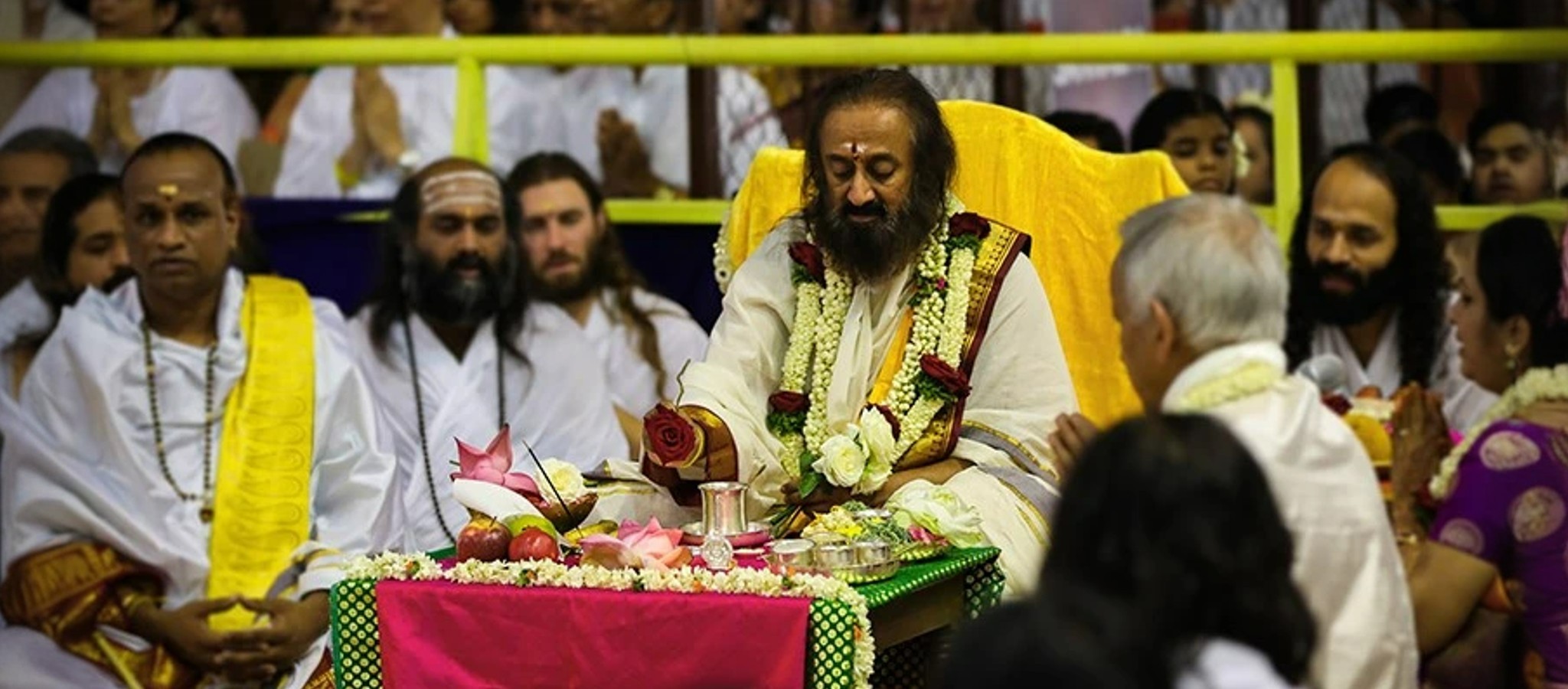
There is only one word in Sanskrit Apah for both water and love. When we take the tirtham, it means – I feel one with everybody. You take a little prasad and you feel content and happy.
Mantras: the Link between the Subtle and the Gross
Mantras are specific and powerful vibrations which are the link between the material and the subtle world. But unless it is connected with the spandan, the deeper vibrations of the self, they remain ineffective. So only those who are in deep samadhi can make the mantra powerful and fruitful; it’s important to experience nothingness for mantras to get charged. That is why whenever any yagya is done, they invite a Guru there who is in yoga, for in their presence only it fructifies.
You can feel a definite difference in the atmosphere when these big yagyas are happening, and mantra chanting is being done here by meditators. The meditators have practised meditation for years with their special mantras. This combination of chanting and meditation creates an environment where everyone can experience deep meditation and happiness. Even people who have never heard the mantras before, but if they have done good meditation, once they hear or sit there, they feel the vibration.
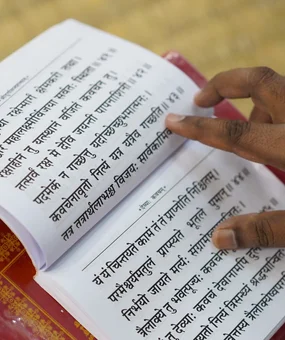
Mantras are the timeless seeds of existence, so the meaning of mantras is not as important as their vibration. So what one has to do is just enjoy the sound and its vibrations. When we recognize this whole universe is one vibration, then the mantras come to us. There is a natural affinity between that state of consciousness and mantras, and then they fructify.
Mantras are a way to heal, to fulfil wishes
Water absorbs the impact of mantras. A scientist in Japan has done a beautiful experiment on the impact of sounds on the water crystals and the water drops; and how when different mantras are chanted, the crystal formation of water is different. So, the mantras can bring the desired result.
In the material world, you need different materials to create different things; but that doesn’t apply in the field of mantra. Any mantra is good enough to bring whatever you desire to have as a result. So mantras transcend the division of material existence; that is why it is so close to the Absolute.
Sankalpa: the Significance, the Secret and the Science
Life cannot move without a direction, so you need to have a goal. So, in all the pujas we take sankalapa; sankalpa is – “at this point of time and space I take this intention,” and then you drop that intention.
The difference between an intention and desire is that in desire you are holding onto it, you become so feverish, and you lose all your energy in holding onto it.
The Rahasya is that the one who can drop the intention is the one whose sankalpa manifests.
Sankalpas come into the mind, and mantras energize the mind. The more thoughts you have, the weaker the sankalpa, and so the sankalpa does not fructify. With mantras, the mind gets energized and centered and in that energized state when a sankalpa is taken up, it is bound to fructify.
Meditation and Our Brain
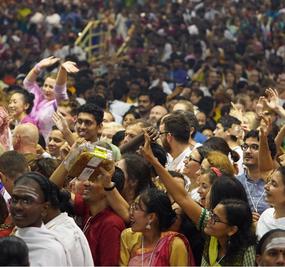
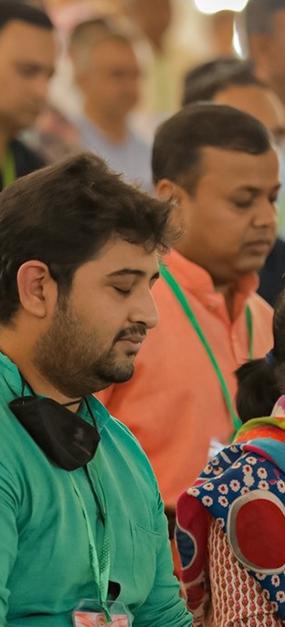
Group meditation elevates the collective consciousness and uplifts the human spirit to be more creative and productive.
The researchers have found that if you meditate for even just 8 weeks or 2 months, the grey matter in the brain increases, it changes the structure of the brain. The brain becomes much more intuitive, creative, and vibrant.
Related reading
- Why Navratri is celebrated
- Navratri as a time for reflection
- The difference between Chaitra and Sharad Navratri
FAQs On Science Behind Navratri Puja
At the Art of Living, Sharan Navratri is celebrated by the blessings of Gurudev Sri Sri Ravi Shankar for the welfare, peace and prosperity for every living being on the planet. Divine blessings are invoked so that everyone obtains wisdom and the following three shaktis:
Ichcha Shakti – Willpower
Kriya Shakti – Power to perform right action
Jnana Shakti – Knowledge of right action
Following are the steps that go into the preparation of the pujas:
First and fore most is collection of materials – Dravya Sangrahana and the quantity of materials required – Dravaya Pramana. These materials are sourced mainly from the state of Kerala, Himachal Pradesh and also from Jammu.
The Second important step is preparation of the area of the Yagnashala which is done in accordance with Yagnashala Lakshana. The procedure is known as Yagnashala Nirmanaand Mandala Lepana(creation of scientific diagrams). Some of the mandals are Ganesha mandala, Vastu mandala, Navagraha mandala and Sudarshana mandala.
The panchabhootas or five elements are worshipped.Water element in kalasha (pot),
fire element as the kinder in the havankunda,
Air element through chanting of mantras,
Earth element is worshipped through the mandalas.
All this worship happens in the interface of the space element.
Then the Panchasana Vedika, the stage to place the main kalasha of the Chandi Yagna is created.The base of the stage is the Koormasana (tortoise, which signifies stability). Above the Koormasana are a series of symbols in the following order:
Above that is Simhasana (lion, which signifies veerya or strength).
Simhasana (lion, which signifies veerya, or strength).
Yogasana (figures of eight siddhas or perfected beings, which are indicative of the Ashtanga Yoga – eight limbs of yoga).
Padmasana (lotus, which represents the state of enlightenment, and full blossoming of consciousness).
Kalasha Sthapana or placement of the pot of water is done into which the energy of the Mother Divine is invoked in this pot.
Preparation of kalashas or the pots is done by threading of the kalasha into which water from holy rivers and medicated herbs are filled. At the top of the kalasham, mango leaves are placed and coconut is placed above the leaves and decorated with sandal paste, Kumkum, Darbha grass and specific scented flowers.
Before the beginning of the yagna, Vaastupuja is done where earth is worshipped and Ankuraarpanam is done wherein nine varieties of food grains are planted all over the Yagnashala on all four sides. This is done to respect the food grains and farmers. These prayers are conducted for increasing the fertility of the land.
Preparation of the Homa Kunda: Homa Kunda is constructed in the east direction of the Yagnashala. Padma Kunda is the type of Homa Kunda which is constructed in our ashram for conducting Chandi yagna.
The other type of kunda is Yoni kunda. The type of Kunda constructed is dependent on the quantity of Dravyas offered for ahuthis, i.e. the quantity materials offered into the sacrificial fire.
Chatusthambha puja or four pillars (Dharma, Gnana, Vairagya and Ishwarya) are erected in the inner portion. In the outer portion, Shodasha Sthamba puja or 16 pillars are erected, which are the 16 aspects of the human life.
Ashtadhwaja, or eight flags, are installed in the outer portion of the Yagnashalas, along with eight patakas or flags, which have elephants on them.
Ashtamangala, or eight equipment, are installed in the inner portion of the Yagnashala. These are Darpanam (mirror), Poornakumbha (pot), Vrishabha (diagram of bull), two Chamaras (hairy fans), Srivatsam (a diagram), Swastikam (a diagram), Shankha (conch) and Deepa (lamp).
In the inner portion decorative drawings or rangolis are drawn and the Yagnashala is decorated with mango leaves, banana stem, sugar cane and lamps are also lit.
The borders of the Yagnashala are also decked up with sown seeds of the food grains, which sprout quickly. The sprouts have the ability to absorb the mantras – Aushadhi mantras. Prayers are done for the food grains to sprout well and bless the smooth conduction of the Chandi yagna.
This is a unique festival where in on one hand, celebration happens and on the other, one can delve deeper to gain knowledge of the self.
Moreover, there are six distortions, or vices of the mind:
Kama (desire),
Krodha (anger),
Lobha (greed),
Moha (infatuation)
Mada (arrogance), and
Matsarya (jealousy).
These distortions can go out of control in any human being, and become an obstacle on the spiritual path. They can be dissolved during these nine days of Navratri, with the grace of Shakti.
Tapasya or upasana are, therefore, performed during these nine days, along with meditation. With the blessings of Pujya Gurudev, we have a ready-made and easy-to- follow spiritual path. By following his guidance, we can attain Siddhi or perfection, through Anima, Mahima, and Lagima.
When sankalpa is taken by an individual for his/her family, it is called Atmartha sankalpa. At the same time, when sankalpa is taken for the benefit of the whole world, it is called Parartha sankalpa.
In Laghu Chandi homa, Avahana or invocation of the Devi is done and is followed by the Navakshari mantra japa. The homa is followed by Devi puja, and is done one time, only for a few hours.
The Maha Chandi homa can be done nine times, and is known as Nava Chandi homa. When performed 100 times, it is known as Shata Chandi homa; when performed 1,000 times, it is known as Sahasra Chandi homa; and, when performed 10,000 times, it is known as Ayuta Chandi homa.
i. What rituals are followed before the commencement of the yagna?
Puja begins with
Guru Anugraha: This is for seeking the guidance and blessings of the Guru.
Devata Anugraha: Here, divine permission is sought.
Vigneshwara puja: This is a prayer to Lord Ganesha, for the removal of all obstacles. It is followed by the Poorvanga pujas.
Acharya anugna: The blessings of the senior-most priest are sought; he heads the whole yagna. The senior-most priest is known as Brahma.
Maha Sankalpa: This intention is taken where in the day, time and place, where the puja is being conducted, is recited. The name and purpose of the homa is also mentioned; the puja begins hereafter.
Graha Preeti: We offer prayers to the nine grahas, or planets, so that the homa can be conducted smoothly without any obstacles. The prayer invokes the blessings of the nine planets, so that the defects, if any, in the nakshatra, rashi and lagna, in which the puja is done, are resolved.
Nandi Shobhanam: Prayers are offered to seek blessings from the rishis and elders.
Madhuparka puja: Milk, honey and ghee are mixed, and a specific mantra is chanted. The priests, who perform the homa consume it, so that they are in a sweet state of mind while performing the puja.
Gaudaana: This involves gifting of a cow, after Gau puja or worshipping of the cow.
Punyahavachana: This purifies the venue where the puja is happening.
Panchagavyam: These are the five elements through which the body is purified.
Vaastu Shanti: This is a prayer to the Bhoomi Devatas.
Mrut Sangrahana: Mruthyu is taken from sand or wood.
Ankurarpana: This involves sowing nine types of grains in pots, which are soaked in milk and water.
Raksha Bandhana: This is the Aacharya’s sankalpa for the puja by tying the sacred yellow thread on the right hand.
These are the rituals (Poorvanga puja) before the commencement of the yagna.
ii. What steps need to be followed as the yagna commences?
There are various steps to be followed once the yagna begins:
Deepa puja: Two types of lamps are placed on either side of the main kalasham. On the left side, the Durga lamp is lit with til (sesame seed) oil and on the right side, the Lakshmi lamp is lit with ghee.
Shodasha Mathruka puja: 16 Mathruka Devis are invoked.
Acharya and Ritvik Varana: Here, acharyas or priests specialised in different branches of the Vedas, Shastras and Agamas, are appointed. The four Vedas – Rig, Yajur, Sama and Atharva, and the Ethihasa Puranaas and Shaivagamas are chanted.
Acharya anugna: The blessings of the senior-most priest are sought. He heads the whole yagna. The senior-most priest is known as Brahma.
Maha Sankalpa: This intention is taken, wherein the day, time and place, where the puja is being conducted, is recited. The name and purpose of the homa is also mentioned; the puja begins after this.
Chandi Maha Yagna Mantapa puja: 53 varieties of main pujas are conducted and the gods of all the 10 directions are worshipped.
Dwara, Thorana, Dhwaja, Pataka, Sthapana: These specific leaves are tied to the mantapa, in accordance with the specific directions.
Acharya Aasana puja: The head priest, appointed to perform the yagna, now, begins Devi puja and does japa of Navakshari mantra.
Gaudaana: Here, a cow is gifted after Gau puja i.e. worshipping of the cow.
Padyaadi Paatra Pari Kalpana: Offerings are prepared.
Kumbha Stapana: The main kalasham, in which the holy water from rivers are filled, is placed.
Pustaka puja and Parayanam puja: Puja is done for the Devi Saptshati book followed by chanting of the Devi Saptshati, which is the Devi Mahatmiyam.
Avahana of Devi: This is the invocation of the Devi.
Agni Karya: A fire is lit by creating friction between the sticks of Aruni wood – Agni Manthana. The Devi is invoked into the fire and then offerings or ahutis are given to the fire. Ahutis are given according to the specific homa being conducted – 1,000, 10,000, 100,000 ahutis, etc. Saptshati is divided into 13 parts, and there is a specific form of Devi for each part. All the 13 Devis are invoked by chanting of mantras specific to them, and specific ahutis are also given to them. This results in obtaining specific effects by the blessing of that specific Devi.
Yogini and Bhairava Puja: The Puja is done for the 64 yoginis and 64 bhairavas to worship them.
Kadambari puja
Vaduka Bhairava puja
Gau puja (Cow worship)
Gaja puja (Elephant worship)
Ashwa puja (Horse worship)
Kanyaka puja (Puja of little girls)
Suvasini puja (Puja for married women)
Dampati puja (Puja for couples)
Several offerings are given to all of them with mangalarati.
Soubhagya Dravya Samarpana: 108 varieties of medicinal herbs and fruits are offered into the main Homa Kunda, along with the chanting of Srisuktha mantra.
Vasodhara: The Chamaka mantras are chanted now.
Maha Poornahuthi: This is the final offering of a red saree, ghee, and honey in a dry coconut, Navaratnasor nine precious gems, and Panchalohas or five types of metals.
Samyojana: The effects and vibrations of the puja are transferred to the main kalasham or pot.
Rakshadharana – Raksha is taken from the Homa Kunda and applied to the main kalasham, followed by puja.
Kalashabhishekam – The sacred water from the main kalasham is now offered to the idol of the Goddess.
Special prayers are done, and blessings are given to the whole earth. The sacred water is now sprinkled by Poojya Gurudev on all those who have assembled there.
The Guru then gives prasadam, and blesses everybody.
They follow the system of Gurukul’s Training Program’s rules and regulations.
They are also given Mantra Deeksha to enable them to perform the Chandi homa. They are well trained in each and every step of the homa, and this helps in maintaining the precision as far as time is concerned on the day of the Chandi homa. The students are given training in a practical Chandi homa, at the Agama Patashala, a week before the Maha Chandi homa.
About 12 weeks of practice of the chanting of Devi Mahatmiyam also takes place.
(b) Subrahmanya homa – Lord Subrahmanya is the god of victory. To succeed in any endeavor, Jnana Shakti, or the energy of knowledge, is needed. So, Bramhanya mantras are chanted and Lord Subrahmanya is invoked.
(c) Navagraha homa – Navagrahas, or the nine planets, are important, and their movements or Grahagathi influence the whole earth and every individual living on it. So, the nine planets are honored by offering nine different varieties of ahutis. This is accompanied by chanting of the mantras, which are specific to each planet. Specific planets influence specific parts of our body and they also influence specific grains and gems.
Planets have an influence on every happening on earth. We pray to the nine planets to decrease or ward off their negative influence on us, and to further enhance the positive influence they are, already, exerting on us.
(d) Rudra homa – The Rudra homa gives us peace, and removes all the sadness from our lives. Rudra mantras, including Namaka and Chamaka mantras, are chanted during this homa. Honoring Rudra mantras helps us go deep in meditation and brings a balance of Sattva, Rajas and Tamas. Rudra mantras dissolve the three gunas and help us enter the state of nothingness in deep meditation. At The Art of Living International Center, 11 priests perform the Rudra homa by chanting the Rudra mantras eleven times; and this is known as Ekadasha Rudra homa.
(e) Sudarshana homa – The Sudarshana homa wards off the evil eye and negative influences, and leads us to bliss. The Sudarshana mantra and Vishnu Sahasranamam are recited during this mantra. Lakshmi mantra and Sri Sukhta mantras are also chanted during the Sudarshana homa.
(f) Rishi homa – This homa is done on the last day of Navratri. Rishis are the Drishtaaraha – those who have entered deep samadhi and downloaded the mantras from the Vedas from space. We perform the Rishi homa to express our gratitude to the rishis who have given this sacred knowledge for the upliftment of mankind. Prayers are done for the Saptharishis and other important rishis, and this begins with the Guru Puja.
To my knowledge, by the grace of Poojya Gurudev and as per his vision, this happens only at The Art of Living International Center.