

Have you observed what is happening in your mind every moment? It vacillates between the past and the future. It is either in the past occupied with what has happened or in the future thinking about what you have to do. Even now, as you are reading this, you will see that the mind is taking breaks to go to the past or future, thinking about what you’re going to do in the next few hours or what has happened in the past. All of this just clogs our mind, our thinking and our intuitive ability and innovative spirit. This is where the focus weakens.
With our eyes closed, we get lost in our own thoughts, in our dreams. Eyes open, we are lost outside here. Eyes open, you’re lost in this dimension. Eyes closed, you just drift away, and you are lost in another dimension.
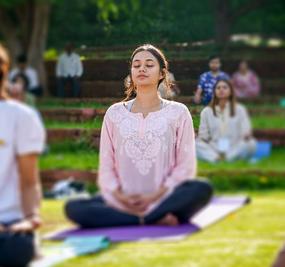
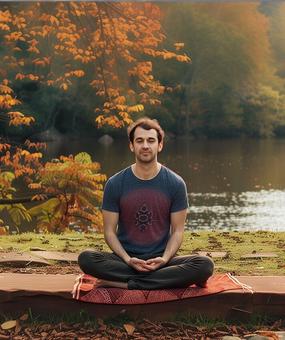
Meditation helps to focus the mind. It brings out the focus in the mind. Meditation sharpens the mind through focus and expands the mind through relaxation. Meditation also helps us to let go of expectations by allowing the mind to rest more and more in the present moment. By opening the mind to being more aware through regular meditation, we become more fulfilled and calm in the moment. And then focus and concentration happen spontaneously.
Why Is Focus and Concentration Difficult?
Distractions happen because the mind jumps from one thing to another. The mind always flows towards something that is even more charming. At least, it perceives that something is more joyful. It may not really be the source of joy. In reality, it is not the source.
When you are having very good food, you are attentive to the food. However, when something on television comes or beautiful scenery comes in front of you, you forget about the food and watch the scenery. Your mind goes from this to that. Your mind always goes to something that seems to be more enjoyable. Most often, it is the senses taking the mind for a ride.
Continuous bombardment of the senses by stimuli can cause inertia. For example, when you watch too many movies or spend a lot of time on social media, the mind is bombarded with so many impressions that it feels confused. But it has become our habit now to binge-watch movies and shows and keep scrolling social media.
Meditation Is Not Concentration
Many of us think meditation is concentration, but it is not. Concentration is effort—forcing the mind to stay in one place, which is not its natural tendency. Meditation is the opposite. It is defocusing. It may sound surprising, but meditation is not about making the mind do something; it is about letting go and allowing the mind to be at rest.
Meditation is not an effort to concentrate on the tip of the nose, the centre of the forehead, or any other point. It is the simple art of doing absolutely nothing, not even thinking. It is deep rest—a conscious relaxation. In this state of effortlessness, the mind naturally settles.
This relaxed state is the mother of concentration. When needed, focus arises on its own, without strain. If concentration is required, gentle attention is enough. Using the breath as a tool, the mind can come to stillness effortlessly. You simply allow meditation to happen.The balance between a focused mind and expanded consciousness brings clarity and perfection. Meditation sharpens the mind through focus and expands it through relaxation, serving as a powerful tool for calmness and clarity. Research on brain function and EEG findings of SKY meditators shows increased alpha waves for relaxation and beta waves for heightened awareness, demonstrating meditation’s potential to improve concentration.(1)
Benefits of Meditation for Focus and Concentration
Meditation sharpens the mind through focus and expands the mind through relaxation. Meditation serves as a valuable tool to bring calmness and clarity. Electroencephalogram studies support this by showing that Sudarshan Kriya induces a unique state of relaxed alertness in the brain.(3)
Concentration is a byproduct of meditation. Practising meditation adds time to your day and energy to your body. A regular practice can transform the quality of your life by cultivating the nervous system to maintain peace, energy and expanded awareness throughout the day.
You can’t directly achieve concentration, but if you meditate for a few minutes, your mind will be very focused. Rest and activity are opposite values, but they complement each other. The deeper the rest, the more dynamic the activity.
Meditation brings out focus in the mind. It makes the body healthy and robust.
How to Meditate
To begin meditating, one can start in one’s own home. There are a number of guided meditations available on YouTube under Gurudev’s meditation channel and also in apps such as the Art of Living app and the Sattva app, which can help you relax and go deep. Taking time for yourself every day is crucial, as meditation is a form of mental hygiene, similar to dental hygiene, and can uplift your spirit and make you feel calm.
In meditation, you need three things: the body is still but relaxed, your eyesight is fixed, and then the mind becomes still. Sit comfortably with your spine erect and body relaxed. Keep your eyes open and fix your gaze at a point in front of you. Then follow along with the instructions in the video.
Here is a meditation that will help you increase your focus:
Intuition Process
Unlock Your
Child's Potential
Support your child in developing focus, resilience, confidence,
emotional well-being, and better decision-making skills.
After a few days of using this and other guided meditations on the channel, you may want to go deeper by learning a meditation technique which you can do on your own. You can learn more about meditation here.
Common Challenges to Meditation
When starting meditation, one might feel restless or find the mind wandering. Meditation is not about stopping thoughts but observing them without attachment.
One of the biggest deterrents for people not being able to meditate is that they don’t have enough time. Yet when they start to meditate, they find they have more time.
To learn about other challenges and ways to overcome them, you can read this article.
Other Techniques for Focus and Concentration
Love
You cannot directly control the mind. It’s not possible. But the mind gets focused when you like something. Then the mind is there fully. If you love something, you don’t need to focus. Focus is already there. Love brings focus along with it.
Once you fall in love with something or are passionate about it, focus comes all by itself. There is nothing needed to create focus. Suppose you like a game, or you like a movie, then for two or three hours, you are really focused. The mind gets focused when there is a liking for a particular activity.
Breathing
Pranayama breathing is another technique for focus. Suppose you don’t like something, but you have to focus. Then take the help of the breath. Breathing can help the mind focus. Using the breath as a tool, bringing the mind to a standstill is possible.
Eye Movement (Tratak)
Our mind is connected with the movement of the eyes. To bring focus, just sit and put your attention on one thing. Don’t close your eyes. With gentle effort, keep your eyes open and look at just one thing. This is also called Tratak—Tratak is just looking at one point.
Social Media Discipline
You cannot avoid social media; you cannot run away from it. When we feel disconnected from nature and bury ourselves in our cell phones and iPads, it affects our central nervous system very badly. Conscious effort needs to be made to keep yourself free from it at least for some time in some places.
Make a policy that you won’t pick up the phone till sometime before breakfast. Reserve a few hours in the morning for yourself. Use that time to be with nature. Meditation in nature could be a very good combination. You will certainly see your focus levels improve.
Gratitude
In gratefulness, everything that supports life grows. When people grumble all through life, their minds don’t focus properly. Being grateful is the key to understanding consciousness, which is power, energy, beauty and wealth which permeates all creations, and it leads to a focused mind.
Conclusion: Being in Knowledge
The nature of the mind is to waver. Now, how do you reduce this wavering nature of the mind? It is through the practice of meditation and dispassion in your approach.
Meditation is a journey from sound to silence and from movement to stillness. It is a practice that adds time to your day and energy to your body.
References
- Greater mental alertness observed in SKY practitioners. [Research summary of 15+ published research papers done on Sudarshan Kriya and meditation practices.]
- Intuition Process: A unique yoga and breathing program that enhances intuitive ability and cognition in children. [Kanchibhotla et. al. International Journal of Current Advanced Research]
- Experienced SKY meditators exhibit increased alpha waves (relaxation) alongside bursts of beta waves in frontal regions (heightened awareness) when at rest. [Research summary of 15+ published research papers done on Sudarshan Kriya and meditation practices.]
Frequently Asked Questions
With the integration of meditation into one’s daily life, a fifth state of consciousness, called cosmic consciousness, dawns. Cosmic consciousness means perceiving the whole cosmos as part of oneself. When we perceive the world as a part of us, love flows strongly between the world and us. This love empowers us to bear the opposing forces and the disturbances in our lives. Anger and disappointment become fleeting emotions that occur momentarily and then vanish. Our mind is calmer and more in the present moment. We are able to focus easily.
Our attention span is reducing day by day. Breathing and meditation help us to get over this attention-deficiency syndrome, and there is more intuitive ability that comes up within you. You become more creative, and this is what you want. Whether you are in business or in academics, all that you need is an intuitive ability from within.
To be consistent in meditation practice and make it part of your life forever, you need to do it at least one mandala, which is 45 days, that consists of two full moons and two new moons.
A practice that combines breathing techniques such as Sudarshan Kriya and meditation, such as Sahaj Samadhi Meditation is optimal for focus and concentration.
You just let meditation happen effortlessly. In meditation, you don’t do gymnastics with the mind, you don’t force anything, you don’t concentrate. Unfortunately, many people think meditation is an exercise of concentration. That’s not the case. It is deep relaxation. You simply have to let go. And as a result of meditation, you can concentrate better.
Along with meditation, lifestyle also plays an important role. Watch what you are eating, because diet makes a big difference. Junk food can block the mind. If you just keep sitting on a couch watching TV or in front of a computer, circulation becomes less in the body and you tend to feel lazy. It is necessary to do some physical exercise and yoga. In between studies, take some time to relax or listen to music. Have confidence that everything will be okay, followed by prayerfulness—the feeling that only the best will happen to me. With proper food, rest, pranayama, yoga and meditation, whatever is needed for your system will be furnished, and you will be able to grasp more in your studies.